Colorado: A Story Written in Stone, Sky, and People
Colorado at 150: the landscapes, Native communities, statehood, work, and reinvention that shaped the Centennial State.

By Eric Phelan
From the September 11, 2026 inaugural issue of The Colorado Conservative.
A Landscape Billions of Years in the Making
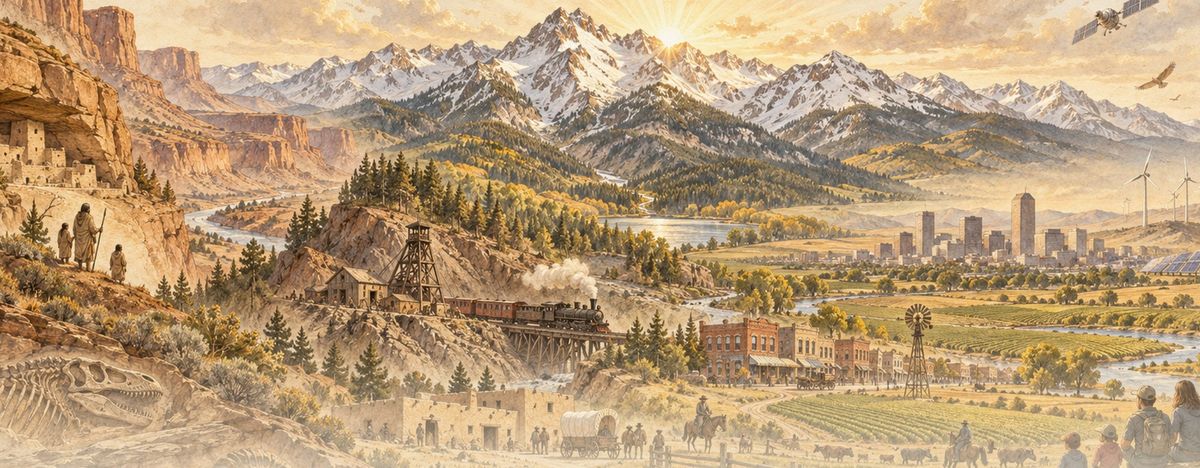
In 2026, Colorado turned 150. Twenty-eight days after the nation celebrated its centennial in 1876, she became the 38th state and earned her enduring nickname: the Centennial State. Her statehood reaches back only a century and a half, but her history runs much deeper. Her borders enclose mountains built across immense spans of geologic time, places inhabited for more than 13,000 years, and communities shaped by many languages, traditions, trades, and journeys.
Colorado has never been defined by a single date. She is ancient and youthful, rugged and welcoming, restless and persistent. She has been shaped by fire and ice, enriched by discovery, scarred by conflict, and strengthened by generations determined to build lives beneath her wide blue sky.
This is Colorado’s story - not simply as a place on a map, but as a land with a personality all her own.
Long before humanity gave Colorado her name and borders, she was part of an ancient continent in motion.
Some of the oldest rocks exposed within her borders today are about 1.7 billion years old. They form part of the deep foundation visible in the Front Range and elsewhere - metamorphic and igneous rock created when pieces of early continental crust collided, heated, folded, and fused.
Colorado did not always look as she does today. Inland seas once covered parts of her landscape, leaving sand, mud, shells, and marine life that eventually became sandstone, shale, limestone, and fossils. The Ancestral Rocky Mountains rose roughly 300 million years ago, stood proudly for ages, and gradually wore down to little more than hills.
Colorado was not finished.
Beginning about 70 million years ago, the Laramide mountain-building event lifted the modern Rocky Mountains. Volcanic eruptions transformed the San Juan Mountains. Rivers carved canyons through stone. Ice Age glaciers shaped high valleys, and the combined work of wind, water, and sediment built the Great Sand Dunes over hundreds of thousands of years.
From those transformations, Colorado emerged with remarkable variety: shortgrass prairie in the east, delicate alpine tundra above timberline, high desert and canyon country in the west, and broad valleys sheltered between soaring ranges.
The Continental Divide became her great spine, where snow gathered and melted feeding rivers like The Colorado, Rio Grande, Arkansas, and South Platte that carry mountain water to farms, cities, landscapes, and oceans far beyond her borders.
Colorado’s stone gave her strength. Her snow and rivers gave her life. Her mountains gave her the unmistakable silhouette by which people around the world would one day recognize her.
Before Colorado Had Her Name
The first known human story in this region reaches back to the end of the last Ice Age.
Archaeological sites such as Lindenmeier in northern Colorado preserve evidence of Paleoindian peoples who hunted, made finely crafted stone tools, gathered plants, and moved with the seasons. Later peoples developed new technologies and increasingly varied ways of living across the plains, mountains, valleys, and plateaus.
These early inhabitants learned Colorado’s temperament. They understood the sudden storms, severe winters, dry plains, high passes, migrating animals, and brief mountain summers. They knew where water could be found, which valleys offered shelter, and when the high country would welcome travelers - or turn them back.
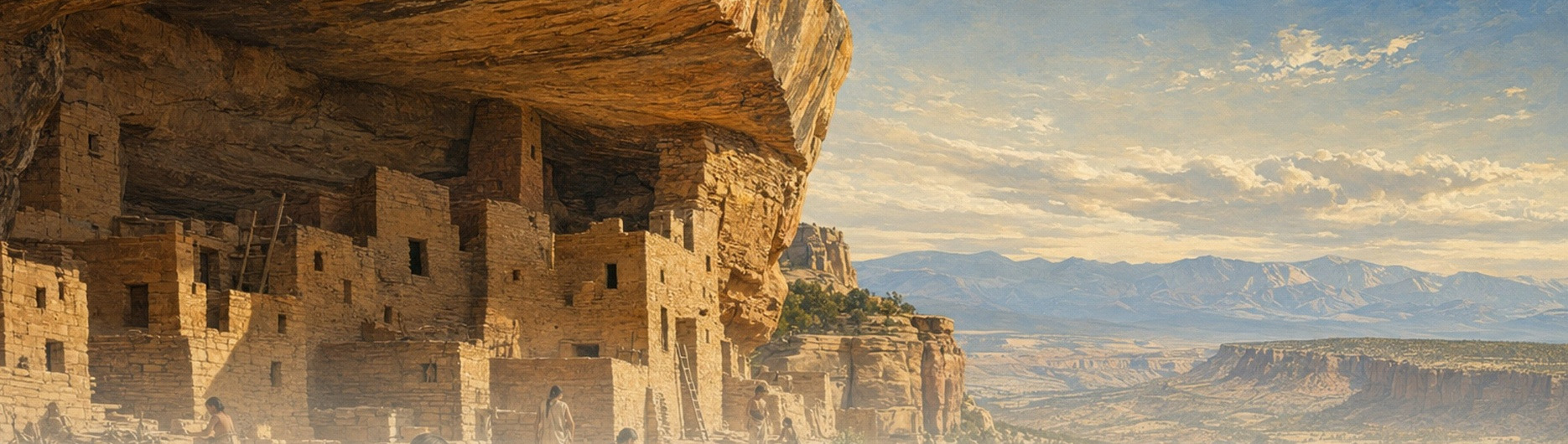
In southwestern Colorado, the ancestors of today’s Pueblo peoples built thriving communities at Mesa Verde for more than seven centuries, from about 600 to 1300 CE. They farmed corn, beans, and squash, shaped sandstone into masonry, constructed reservoirs and terraces, and built villages first on mesa tops and later in sheltered cliff alcoves.
Their migration south in the late thirteenth century did not end their story. Their descendants include the Hopi, Zuni, Acoma, and Rio Grande Pueblo peoples, whose living traditions remain connected to Mesa Verde.
Colorado was never the homeland of only one people. Ute bands lived throughout the mountains and western valleys for generations, traveling familiar seasonal routes and developing deep knowledge of the high country. Cheyenne and Arapaho communities became central to life on the eastern plains. Apache, Comanche, Kiowa, Lakota, Navajo, Pueblo, and Shoshone peoples also traveled, traded, hunted, or lived within parts of the region at different times.
Trails crossed Colorado’s mountain passes and followed her rivers long before those routes appeared on modern maps.
Today, the Southern Ute Indian Tribe and Ute Mountain Ute Tribe maintain homelands in southwestern Colorado, while other Native nations preserve enduring cultural and ancestral ties to places across the state. Their histories are not simply the opening chapter of Colorado’s story. They remain part of who she is.
A Crossroads of Worlds
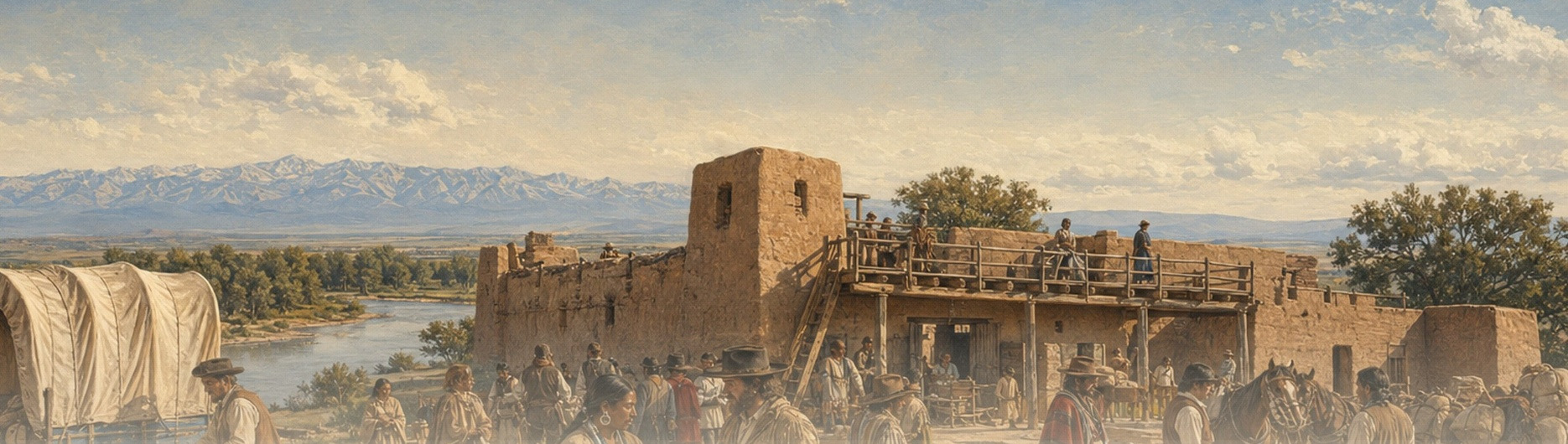
After Spain established New Mexico in 1598, Spanish expeditions entered present-day Colorado. During the 1700s, explorers and traders traveled through the San Luis Valley, across the Western Slope, and along the Arkansas River. The Dominguez-Escalante expedition crossed western Colorado in 1776, recording landscapes and routes already familiar to Native peoples.
Spanish words remain written across her map today: Sangre de Cristo, San Juan, Mesa Verde, and Colorado.
The early nineteenth century made the region an international borderland. The United States claimed land east of the mountains through the Louisiana Purchase, while Spain and later Mexico governed territory to the south and west. Lieutenant Zebulon Pike’s 1806-07 expedition brought wider American attention to the southern Rockies. He tried to climb the mountain that would later bear his name but was turned back by snow, cold, and the peak’s greater-than-expected distance.
It was an early demonstration of Colorado’s personality: beautiful enough to invite exploration, but formidable enough to demand respect.
After Mexico gained independence in 1821, the Santa Fe Trail became a busy corridor for commerce and travel. Bent’s Old Fort, built along the Arkansas River in 1833, became one of the great meeting places of the borderlands.
Cheyenne and Arapaho families traded bison robes; merchants arrived from Missouri, Taos, and Santa Fe; and travelers rested, repaired wagons, exchanged news, and heard many languages within its adobe walls.
Following the Mexican-American War and the Treaty of Guadalupe Hidalgo in 1848, the United States took control of much of the remaining land that would become Colorado.
Hispano families moving north from New Mexico established permanent agricultural communities in the San Luis Valley. The town of San Luis, founded in 1851, is Colorado’s oldest continuously occupied town. Its adobe buildings, acequia irrigation traditions, communal pasture, faith, foodways, and family histories remain among her strongest living links to the Spanish and Mexican eras.
Gold, Territory, and Statehood
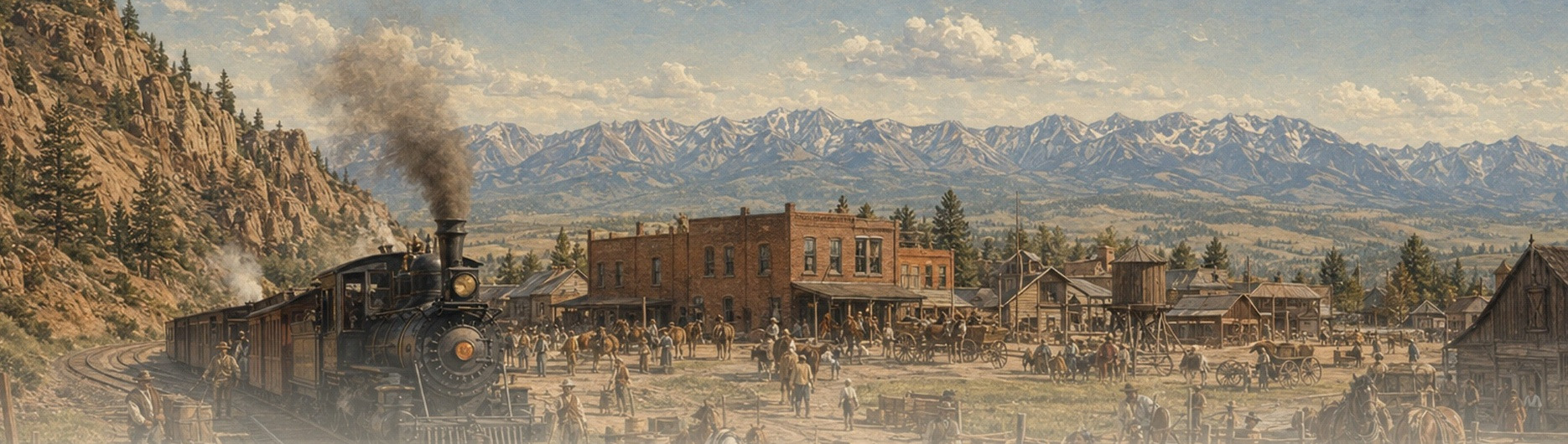
Gold discoveries in 1858 and 1859 changed Colorado’s pace almost overnight.
The cry of “Pikes Peak or Bust!” brought tens of thousands of fortune seekers west, even though the richest early strikes were far north of Pikes Peak. Many arrived expecting Colorado to surrender her treasure easily. Most soon discovered that she demanded persistence, ingenuity, and a tolerance for disappointment.
Denver and Auraria rose near the meeting of Cherry Creek and the South Platte. Golden, Central City, Black Hawk, Boulder, and mountain camps grew rapidly. Merchants, farmers, ranchers, builders, teamsters, and craftspeople soon discovered that supplying the mining country could be as important as finding ore.
Congress created Colorado Territory in 1861 from portions of Kansas, Nebraska, New Mexico, and Utah territories. During the Civil War, Colorado volunteers marched south and helped stop a Confederate advance at Glorieta Pass in 1862.
The territorial period also carried profound loss. As newcomers occupied Native homelands, agreements failed and conflict intensified. At Sand Creek on November 29, 1864, Colorado troops attacked a Cheyenne and Arapaho village, killing more than 230 people, many of them women, children, and elders. The massacre remains one of the most painful events in Colorado’s history and an enduring scar upon her story.
Statehood did not come immediately. After years of debate over boundaries, representation, finances, and a constitution, Congress approved an enabling act. Delegates drafted a constitution in 1875-76, and Colorado voters accepted it.
On August 1, 1876, President Ulysses S. Grant proclaimed Colorado the 38th state - during the centennial year of the Declaration of Independence. The timing gave her the nickname she still proudly carries: the Centennial State.
Statehood opened another era of change. Silver discoveries fueled Leadville and the San Juan mining country. Railroads climbed canyons and crossed high passes, linking ore, cattle, crops, timber, coal, and people to distant markets. Denver became the permanent capital.
Settlement and mining also brought continued pressure on Ute lands. By the 1880s, most Ute people had been forced from large portions of their Colorado homeland, while the Southern Ute and Ute Mountain Ute communities remained in the southwest.
Colorado had officially joined the Union, but she was still becoming herself.
Building the Centennial State
The Colorado that emerged after 1876 was built by many hands.
Miners came from Cornwall, Wales, Ireland, Italy, Greece, Germany, Eastern Europe, Mexico, China, and Japan. Black homesteaders and entrepreneurs established homes and businesses, including the agricultural community of Dearfield on the eastern plains. Hispano communities expanded northward, and new farming towns took root along rail lines and irrigation ditches.
Colorado rewarded hard work, but she rarely made it easy.
Agriculture became as important to Colorado as mining. Cattle and sheep ranches spread across her plains and mountain parks, while farmers grew wheat, corn, sugar beets, beans, fruit, melons, and vegetables in places once dismissed as too dry. Irrigation ditches, reservoirs, and canals connected mountain snow to farms and communities. Sharing a scarce and unpredictable water supply became a permanent feature of life in a state generous with beauty but stubbornly careful with rain.
Colorado also earned a place in the national movement for women’s voting rights. In 1893, she became the first state to approve women’s suffrage through a hard-earned referendum.
Towns built schools, libraries, courthouses, theaters, churches, synagogues, newspapers, and civic organizations. Mining remained dangerous, however, and disputes over safety, wages, and working conditions sometimes turned violent. The 1914 Ludlow Massacre, where striking coal miners and their families were attacked, became a nationally remembered turning point in labor history.
Coloradans became early champions of preserving exceptional places. Mesa Verde became a national park in 1906 to protect the archaeological heritage of Ancestral Pueblo people, followed by Rocky Mountain National Park in 1915. Later generations protected the Great Sand Dunes, Black Canyon of the Gunnison, historic trails, battlefields, mining districts, grasslands, and wildlife habitat - preserving Colorado’s beauty alongside the memories of those who lived and worked within her borders.
Hard Years, Service, and Reinvention
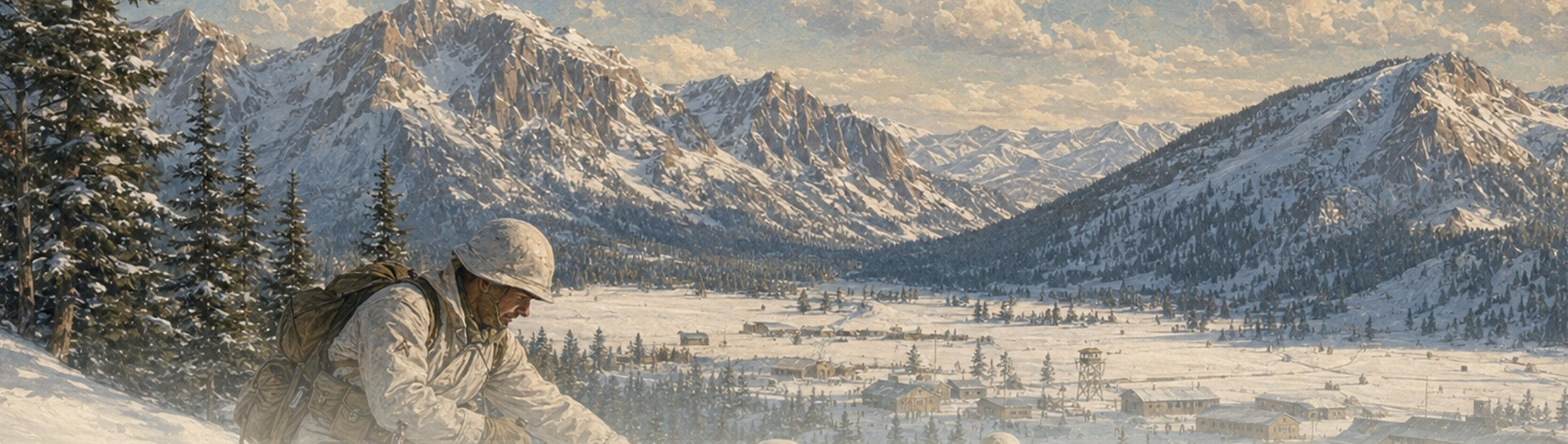
The twentieth century tested Colorado’s resilience.
The Great Depression and the Dust Bowl struck farms, ranches, mines, banks, and small towns. Wind carried away unprotected topsoil on the eastern plains, and many families left. Others stayed and rebuilt through improved farming practices, soil conservation, local cooperation, and New Deal projects.
The Civilian Conservation Corps constructed trails, roads, campgrounds, and public facilities that Coloradans still use.
Colorado bent during those hard years, but she did not break.
During World War II, Colorado trained soldiers, produced military goods, and welcomed new bases. At Camp Hale, she became a demanding instructor to the Army’s 10th Mountain Division. Her altitude thinned the air, her snow punished mistakes, and her mountains forced soldiers to become stronger and more resourceful before fighting in Italy. After the war, many veterans returned to help develop ski areas, outdoor-equipment companies, and a culture of mountain recreation known around the world.
The wartime story also includes Amache near Granada, one of ten camps where the federal government incarcerated Japanese Americans removed from the West Coast. More than 10,000 people passed through Amache from 1942 to 1945.
Within the camp, families created schools, farms, gardens, sports teams, art, newspapers, and businesses under extraordinarily difficult circumstances. Former incarcerees and local students later led preservation efforts so that this history would not be forgotten.
Postwar Colorado grew quickly. Federal laboratories, universities, military installations, medicine, telecommunications, and aerospace diversified an economy long rooted in agriculture, mining, energy, manufacturing, and tourism.
NORAD was established in Colorado Springs in 1958, and its Cheyenne Mountain complex became an international symbol of the space age. The Solar Energy Research Institute - later the National Renewable Energy Laboratory - opened in Golden in 1977.
Highways, airports, ski areas, suburbs, and expanding cities connected more of the state. Colorado was no longer a distant frontier but an emerging center of science, defense, technology, recreation, culture, and enterprise. Even as her cities expanded, rural communities preserved traditions rooted in ranching, farming, mining, and local enterprise.
Colorado at 150 — and Beyond
At her centennial in 1976, Colorado celebrated with community events, historic preservation, and projects such as the reconstruction of Bent’s Old Fort.
Fifty years later, she is home to about six million people and an economy that reaches from family farms and Main Street shops to satellites, bioscience, energy research, advanced manufacturing, tourism, and the arts.
Colorado has changed enormously, but her familiar heart remains easy to recognize.
It is present in a ranch gate on the eastern plains, an acequia in the San Luis Valley, an orchard on the Western Slope, a neighborhood festival, a powder morning, a high-country trail, a school gym on game night, a tribal celebration, a mountain town’s historic main street, and the gold dome of the State Capitol shining above Denver.
She can be difficult. Her winters close roads, her droughts test farms, her altitude humbles visitors, and her distances resist easy solutions. She can also be generous beyond measure - with brilliant sunsets, fertile valleys, clear mountain mornings, abundant wildlife, rich communities, and the almost irresistible promise that something worthwhile waits beyond the next ridge.
Colorado’s history is too large for a single tale. She holds discovery and endurance, enterprise and creativity, hardship and renewal. She belongs to ancient communities and recent arrivals, to cities and small towns, and to plains, peaks, valleys, and plateaus. For 150 years, she has stood as the Centennial State: weathered but beautiful, independent but welcoming, proud of her past and eager to discover what comes next.
Her statehood began in 1876. Her story began long before that. And she is nowhere near finished.
Statehood date reference
Colorado entered the Union on August 1, 1876, during the nation’s centennial year. Library of Congress: https://www.loc.gov/item/today-in-history/august-01/