James D. Kellogg: House District 26 Candidate Interview
James D. Kellogg discusses Western Slope housing, energy, water, and local control in our inaugural issue’s HD26 interview.

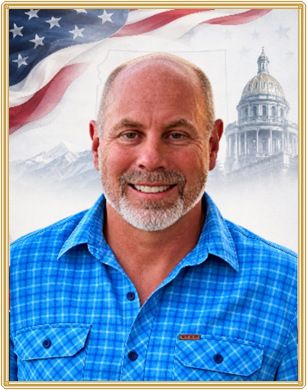
From the September 11, 2026 inaugural issue of The Colorado Conservative. Candidate status and campaign links reflect the printed issue.
Colorado House of Representatives • House District 26 • Candidate in the printed issue
The interview
Who is James beyond the campaign?
I’m a Gypsum resident and I’ve lived in Eagle County since 2019. I previously spent two decades in Garfield County. My wife and I have a blended family of nine kids, all graduates of local high schools. I attend the Vail Church in Avon, where I serve as a volunteer on the life safety team.
I have worked in Colorado for nearly 30 years as an engineering consultant specializing in geotechnical, geologic, and water resources engineering, with projects across western Colorado. I hold a bachelor’s degree in biology and a master’s degree in civil engineering from Virginia Tech.
I previously served on the Silt Board of Trustees. I wrote an opinion column called "Right Angles" that was published in the Glenwood Springs Post Independent from 2011 to 2017. I’m also the author of a thriller novel called "Radical Action: A Colt Kelley Thriller" set in western Colorado.
I’m a long-time conservative, and my top priorities are affordability, maintaining reliable energy, and protecting our West Slope water rights. I’m an advocate for a balanced energy approach that includes traditional energy industries. I understand water rights and the importance of protecting them for our communities. I also have concerns about the safety of our kids, wolf reintroduction, gun rights, and the attacks on Colorado’s TABOR framework.
Why are you running?
Eagle, Moffat, Rio Blanco, and Routt Counties are unaffordable for typical families and businesses. Housing costs are skyrocketing, property taxes keep climbing, and everyday bills are consuming more of our paychecks. I want to cut red tape, reform restrictive zoning and permitting, reduce regulations, and enable the private sector to build affordable housing without government mandates or taxpayer-funded subsidies.
Our district produces much of the energy that powers Colorado, but reckless green-energy mandates threaten to further inflate our utility bills. They will also kill good-paying jobs in oil, gas, and coal and destabilize entire communities. I will reject energy mandates and promote an “all-of-the-above” strategy to utilize our oil, gas, and coal resources, lower our utility bills, and protect Western Slope families and jobs.
I’m concerned about our Western Slope water rights, which are threatened by drought and low snowpack. At the same time, Front Range demands, environmental mandates, and negotiations regarding Colorado River operating guidelines could force curtailment of senior agricultural rights. I will defend Western Slope water rights against growing Front Range demands, top-down environmental mandates, and post-2026 renegotiations of the Colorado River Compact operating guidelines that curtail local, senior water diversions.
What makes your district unique?
House District 26 ties world-class resort economies to an energy-and-ranching economy. A representative of HD 26 must understand and communicate with both.
Vail, Avon, Edwards, and Steamboat Springs capitalize on tourism, second homes, and outdoor recreation. Craig, Hayden, Oak Creek, Meeker, Rangely depend on coal, oil and gas, and agriculture. Average people struggle to afford bare minimum housing in Eagle and Routt Counties while families in Moffat and Rio Blanco Counties worry about plant closures, loss of jobs, and declining community resources.
Towns like Steamboat and Vail are largely populated with new arrivals and part-time residents. Residents of these communities are often split between those with a lot of money and those with a lot of bills. On the other hand, many families have called Meeker, Craig, Hayden, and Oak Creek home for generations. A large percentage of the people here feel their future is uncertain.
We need both of these cultural and economic groups to be successful in order to put Colorado back on the right path. Resorts don’t run without power, water, and people. And rural areas need support for the energy and agricultural products they produce.
What would be your three highest legislative priorities?
Increase housing supply through regulatory reform and local flexibility. This would include streamlining permitting and reducing zoning and regulatory barriers. I would pair this with protecting the local energy sector, especially since reliable, affordable energy is critical for lower housing costs and the broader economy.
Push back against aggressive state mandates and rushed electrification deadlines that threaten reliable energy production, inflate utility bills, and put good-paying Western Slope energy jobs at risk. I will support responsible local energy production, protect energy jobs throughout the Western Slope, and oppose policies from Denver that unnecessarily threaten Western Slope energy production and employment.
Protect Western Slope water rights and expand practical water infrastructure. This would include efforts to improve storage, efficiency, measurement, and infrastructure rather than conservation mandates or buy-and-dry schemes that harm agriculture and rural economies. I will also defend Western Slope water rights in interstate post 2026 negotiations and against new Front Range diversions.
How would you address Colorado’s affordability challenges?
As a state representative, I could work in the General Assembly to lower household and business costs. To address housing costs, we can remove barriers to construction like slow permitting, restrictive zoning, high fees, and overbearing building codes. The private sector needs to be the primary driver of affordable housing instead of government subsidies. We should promote small business by restoring the sales-tax vendor fee, slowing new workplace regulation.
We also need to lower taxes by reducing the rates of income-tax, sales tax, and property tax. The state must operate within reasonable and firm budgets. This means we must insist on balanced state budgets and the integrity of Colorado’s TABOR.
The General Assembly can work to lower the cost of food by promoting and incentivizing state and local agriculture, including farm-to-table operations. The legal and physical availability of our Western Slope water must be fortified for successful agriculture.
To reduce healthcare costs, we can limit surprise facility fees and require real price transparency. We can resist hospital consolidation and promote rural healthcare facilities and jobs. It is important for state representatives to encourage our state senators and representatives to push for more favorable policies on drug prices and Affordable Care Act (ACA) rules.
What is your approach to education?
Education in Colorado should start with the family and not the state. Parents should have access to the curriculum, test results, and disciplinary records without a fight. They should have access to vouchers, scholarships, and tax credits to move their child to private schools, charter schools, and homeschool when a school is failing them.
Teachers should be treated as professionals who are hired and evaluated locally. They must be free to teach reading, writing, math, civics, and science. Their job is not to promote counter-culture agendas. Teachers should be paid for results, with incentives to work in hard-to-staff rural positions.
Local school boards should have more control of curriculum that meets or exceeds state standards, set calendars, manage buildings, The state should be focused on distributing funding districts fairly, setting a short list of academic standards, and protecting open enrollment. The state should not micromanage lesson plans.
I believe it is important to promote early-literacy programs, parent access to CMAS and SAT results, and transparency on what is taught. We must also protect the dignity of girls by keeping males out of their sports and private spaces.
How would you approach public safety and individual liberty?
An important duty of the state is to provide public safety without infringing on liberty more than necessary. Colorado should be tough on violent and repeat offenders, especially those involved in sex and drug trafficking. We should support Initiative 108, which increases the severity of penalties for those who are involved with sex trafficking of minors. At the same time, drug policy should distinguish addicts who need treatment from traffickers who deserve prison.
Law enforcement needs adequate funding and support to do their work. That includes removing policies and laws that make law enforcement officers hesitate on a lawful arrest. We also need faster court timelines. The state should confirm that any proposed alternatives to surety bail have been thoroughly vetted to ensure the appearance of criminals in court and protect public safety while respecting the presumption of innocence.
Colorado should also be held to Constitutional limits that affirm the individual liberties of citizens. State laws that infringe upon the First and Second Amendments should be challenged in court and repealed as soon as possible. The state should also be challenged with respect to polices and laws that violate federal law, such as sanctuary city and state declarations. Surveillance cameras and data should be carefully considered before implementation, and communities should have the choice to opt-out.
What does conservative government mean to you?
Conservative government means the state does a few things well and leaves most decisions to counties, communities, and individuals. The state should be attempting to run housing markets, energy systems, or healthcare. It should focus on public safety, balanced budgets with preservation of TABOR, public roads, a court and prison system that punishes criminals, and basic educational policy.
Colorado should not be involved with social engineering. We need less statewide mandates and fees and fewer enterprises designed to obtain more money from citizens without a vote. Most government decisions should be made at the local level.
How will you turn your principles into results?
I believe it is important to truly define the problems facing House District 26. Good solutions cannot be developed for problems that are not understood or mis-represented. Real solutions should start with input from the citizens and leaders of local communities. Elected representatives are not endowed with knowledge and understanding simply by being elected.
With any proposed legislation, I believe it is important to find good co-sponsors who share the vision, regardless of which side of the aisle they are on. I would also become familiar with interim committees and oversight hearings where a minority member can affect bills. In any case, it will be critical for me to always write down and memorize the non-negotiable part of the solution to any issue.
It’s critical to promote compromise as long as the core objective is still met. For instance, a pilot program can be an acceptable result if it implements a new solution. At the same time, I don’t want to abandon a principle for the sake of a legislation that passes. Compromise is not a housing bill that adds process without additional units or insurance reform that funds a new enterprise without a discount to policy-holders. Voters will accept a smaller win. They won’t accept a bill with my name on it that does the opposite of what I ran on.
Why should voters place their trust in you?
I strive to live by Christian principles. I’ve always tried to be a good husband and dad. I’ve made plenty of mistakes in my life, but I always try to learn and improve. I believe that elected representatives are presented with a duty to serve and not an opportunity for personal benefit. Success is measured by meaningful improvements to the lives of constituents, not the number of bills pushed through the General Assembly. As an elected representative, the fiscal responsibility is no different than required when evaluating your family budget or your business finances. The bottom line matters. I will be a good steward of taxpayer dollars while providing positive and measurable results. I understand that the buck stops with me. At the same time, I will push back on government actions that infringe upon the individual liberties of citizens.
District notes from the magazine
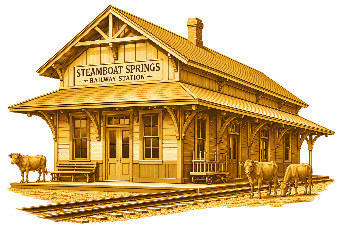
French fur trappers reportedly thought one spring along the Yampa River sounded like the chugging of a steamboat, hence the name Steamboat Springs. The Ute people used the valley as an important summertime hunting territory and regarded the springs as places of healing and spiritual significance. The Denver, Northwestern & Pacific Railroad arrived in 1908, opening the region to year-round passenger travel and commercial shipment of cattle and coal. By 1913, the town’s railroad depot was reportedly the largest cattle-shipping point in the United States.
Dinosaur National Monument extends into HD-26's Moffat County portion. It preserves spectacular canyons, Indigenous rock art and some of the most important dinosaur fossil deposits in North America. Visitors can see more than 1,500 dinosaur bones still exposed in the rock at the Quarry Exhibit Hall. People have lived in the Dinosaur National Monument region for at least 10,000 years. Archaeologists have identified stone tools, dwellings, granaries, petroglyphs and pictographs documenting thousands of years of human activity.
Industries in the district
- Health Care & Social Assistance
- Retail Trade
- Tourism, Hospitality & Food Services
- Construction
- Education
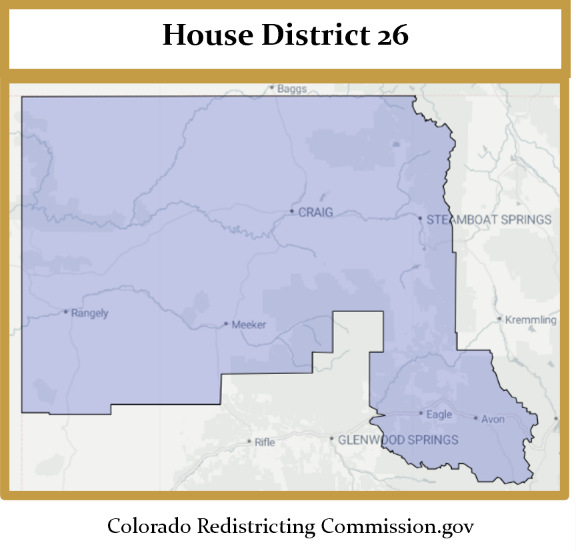
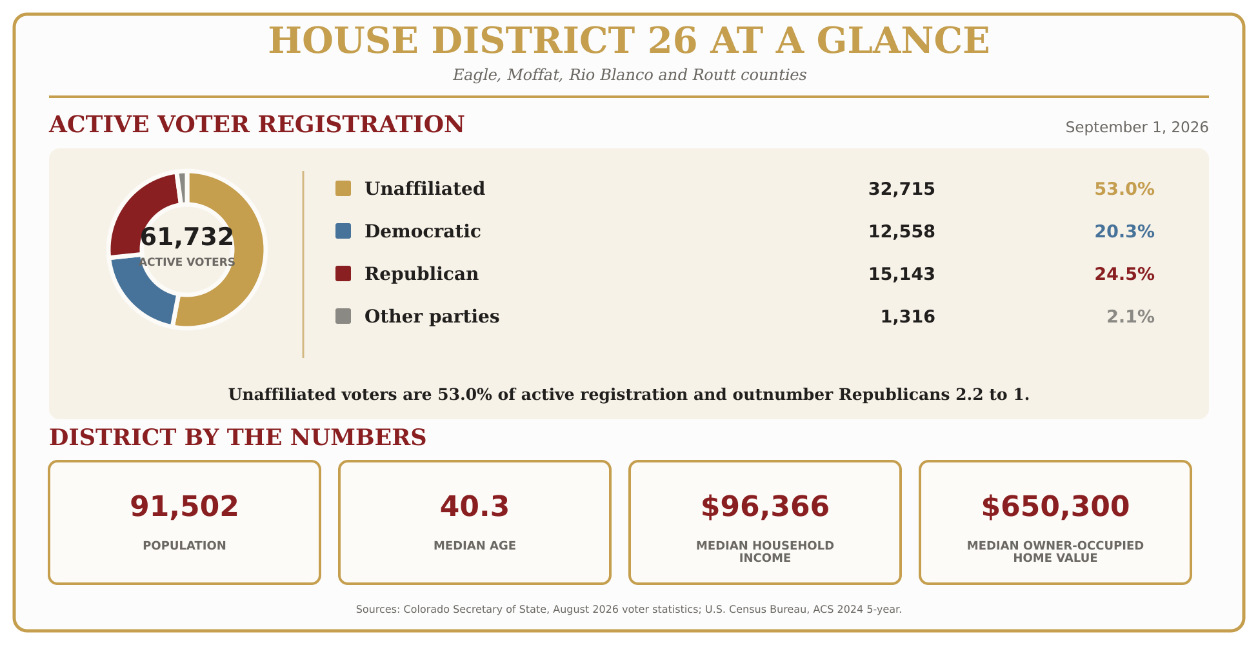
District at a glance