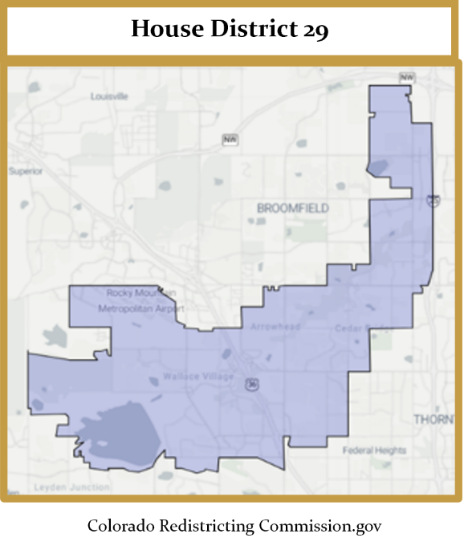
Kristine Ireland: House District 29 Candidate Interview
Kristine Ireland discusses household costs, local control, water, and accountable government in our inaugural issue’s HD29 interview.

From the September 11, 2026 inaugural issue of The Colorado Conservative. Candidate status and campaign links reflect the printed issue.
Colorado House of Representatives • House District 29 • Candidate in the printed issue
Campaign website · Campaign donation link
The interview
Who is Kristine beyond the campaign?
I am a wife, mother of five, grandmother of fifteen, longtime Westminster resident, small-business owner and piano teacher, community volunteer, and currently a Westminster City Councilor. Long before I ever thought about running for office, my life revolved around family, faith, work, and community.
My husband Scott and I have been married for more than 42 years. Raising five children and now watching our grandchildren grow up has shaped how I look at government. I don't view public policy as something theoretical. I think about what a decision means for the family trying to pay its mortgage, the senior trying to remain in the home they have owned for decades, the parents buying groceries and diapers, or the small-business owner wondering whether another tax, fee, mandate, or regulation will be the one they simply cannot absorb.
I became involved in local government because of Westminster's rapidly increasing water rates. I helped lead a grassroots effort demanding greater accountability and affordability. That experience taught me that ordinary citizens really can make a difference when they are willing to get involved, do their homework, and refuse to give up.
Eventually, that involvement led me to City Council. I didn't enter public service because I wanted a political career. I entered it because I believed residents needed someone willing to ask difficult questions and challenge government when it wasn't working for the people paying the bills.
That is still what motivates me today.
Why are you running?
I am running for the Colorado House because many of the problems I deal with at the city level increasingly originate at the State Capitol.
Colorado has become dramatically less affordable. State mandates increasingly restrict local decision-making. Families, homeowners, businesses, school districts, and local governments are being asked to absorb higher costs while having less control over decisions affecting their own communities.
People repeatedly encouraged me to consider running for the legislature because they had watched how I served on City Council. I have been willing to vote no when I believed something was wrong, even when I was the only vote. I have also worked with people across political lines when we could find practical solutions that benefited residents.
My experience on City Council has prepared me well for the legislature because I understand budgets, land-use decisions, water infrastructure, public safety, housing, taxation, local government, and the real-world consequences of state mandates.
I am running now because I believe Colorado needs more legislators who will ask a very basic question before voting: How will this affect the people who have to live with it and pay for it?
What makes your district unique?
House District 29 is my home. These aren't simply voters to me; they are my neighbors.
Westminster and the surrounding communities include young families, retirees, longtime homeowners, renters, small-business owners, teachers, first responders, and people who have worked very hard to build a life here. We have wonderful neighborhoods, parks, open spaces, schools, businesses, and a strong sense of community.
But the concern I hear more than anything else is affordability.
People feel squeezed from every direction: property taxes, rent, insurance, utilities, groceries, energy, HOA costs, healthcare, and fees. Many people earn more than they did several years ago yet feel as though they are falling further behind.
I also hear concerns about public safety, education, parental rights, housing, government spending, water, overdevelopment, and the increasing loss of local control.
People don't expect government to solve every problem. They want government to perform its essential responsibilities well, spend their money responsibly, protect their rights, and stop making everyday life unnecessarily expensive.
What would be your three highest legislative priorities?
My three highest priorities would be affordability, local control and accountable government, and strong families and safe communities.
First, affordability. I would scrutinize legislation for its impact on household costs and oppose unnecessary taxes, fees and mandates that make housing, energy, insurance, transportation, groceries, and doing business more expensive. I would like major legislation with a significant economic impact to include a clear Household Cost Impact Statement so legislators and the public can see what a proposal is expected to cost Colorado families before it becomes law.
Second, local control and accountable government. Colorado is a diverse state, and decisions that make sense in one community may make little sense in another. I would work to restore appropriate authority to cities, counties, school boards, and citizens rather than continually concentrating decision-making in Denver. I would also push for greater transparency and accountability in state spending.
Third, strong families and safe communities. That means supporting parents in education, strengthening academic fundamentals, supporting law enforcement and first responders, holding repeat and dangerous offenders accountable, and protecting constitutional rights.
Those priorities all come back to the same principle: government should serve people rather than expecting people to serve government.
How would you address Colorado’s affordability challenges?
There is no single bill that will make Colorado affordable again. But the General Assembly can stop making the problem worse.
Every tax, fee, regulation, mandate, insurance requirement, energy policy, and housing regulation ultimately gets paid by somebody. Usually that somebody is a Colorado family or small business.
I would start by requiring legislators to acknowledge those costs before voting. That is why I support a Household Cost Impact Statement for significant legislation.
On housing, we need to increase supply while respecting property rights and local communities. The state should remove unnecessary barriers rather than simply imposing one-size-fits-all density mandates on cities.
On energy, affordability and reliability must matter alongside environmental goals. Consumers should retain reasonable choices, including natural gas, rather than having government dictate increasingly expensive alternatives.
On taxes and fees, Colorado should live within its means just as families do. When revenues grow, the first instinct shouldn't always be finding another program on which to spend the money.
We should also examine regulations contributing to rising insurance and healthcare costs and make Colorado a more competitive place for small businesses.
My test is simple: Does this policy make it easier or harder for an ordinary Colorado family to afford to live here?
What is your approach to education?
Parents are the primary decision-makers in their children's lives. Teachers are professionals entrusted with educating those children. Local school boards should be accountable to the communities that elect them. The state's role should primarily be ensuring transparency, academic standards, equal opportunity, and responsible use of taxpayer dollars, not micromanaging every classroom.
I support parental rights, school choice, charter schools, homeschooling, and traditional public schools. Different children thrive in different environments, and parents should have meaningful options.
I want schools focused first and foremost on academic excellence: reading, writing, mathematics, science, history, civics, critical thinking, and the skills students need to succeed in adulthood.
Teachers should be able to teach, rather than being overwhelmed with administrative requirements and constantly changing mandates.
Most importantly, parents should never be treated as obstacles to their children's education. Schools work best when parents and teachers are partners.
How would you approach public safety and individual liberty?
Public safety and individual liberty are not competing principles. A free society needs both.
Government has a fundamental responsibility to protect people from violence, theft, drugs, property crime, and other threats. I support our law-enforcement officers and first responders and believe they need the staffing, training, resources, and legal support necessary to do their jobs.
We also need meaningful accountability for repeat and dangerous offenders. Compassion does not require tolerating behavior that makes neighborhoods unsafe or leaves law-abiding residents afraid to use their own parks and public spaces.
At the same time, law enforcement itself must operate within the Constitution. Due process, free speech, religious liberty, property rights, privacy, and the right to equal treatment under the law are not optional.
I have been willing to defend constitutional principles even when doing so was politically unpopular. Government's responsibility is to enforce the law fairly while remaining constrained by the law itself.
What does conservative government mean to you?
To me, conservative government means limited, accountable, fiscally responsible government that respects individual liberty, families, private property, and local decision-making.
Government should do its essential jobs extremely well: protect public safety, maintain infrastructure, safeguard constitutional rights, provide appropriate services, and responsibly manage taxpayer dollars.
It should do less micromanaging of people's lives and local communities.
And it should stop treating every problem as justification for another tax, fee, mandate, bureaucracy, or government program.
Being conservative also means recognizing that taxpayer money belongs to taxpayers. Government has an obligation to demonstrate that money is being used effectively before asking citizens for more.
I believe in local control because the government closest to the people is generally the easiest for citizens to hold accountable.
And I believe government should trust people more. Colorado became a great state because of hardworking families, entrepreneurs, communities, charities, churches, and civic organizations - not because government directed every aspect of their lives.
How will you turn your principles into results?
Local government has taught me that very little gets accomplished if your objective is simply to defeat the other side.
I will work with anyone, Republican, Democrat, Independent, or otherwise, when we share a goal that benefits the people I represent.
I listen. I ask questions. I research issues. And I am willing to change details of a proposal when someone has a better idea.
But compromise is different from surrendering a core principle. Productive compromise means two sides finding a workable solution without either side abandoning the fundamental reason they entered the discussion. If a proposal can be improved through negotiation, I will negotiate. If something violates constitutional rights, imposes an unacceptable burden on taxpayers, or fundamentally conflicts with the interests of my constituents, I am also willing to vote no.
On City Council, I have sometimes been the lone dissenting vote. At other times, I have helped move ideas forward by finding common ground.
The goal isn't to win political arguments. The goal is to get good results for the people we represent.
Why should voters place their trust in you?
I don’t ask voters to trust me because of a party label. I ask them to look at how I have already served.
I have questioned spending, opposed tax increases I believed were unnecessary, fought for water affordability, supported public safety, defended local control, pushed for transparency, and stood up for residents even when doing so wasn’t politically convenient.
I also made a deliberate decision about how I would run this campaign. I do not want to be beholden to PACs, dark-money organizations, or powerful political interests. My campaign is funded by individuals because I want the people I represent to know exactly who I work for.
My commitment is that I will continue doing what I have done on City Council: read the material, ask the difficult questions, listen to residents, follow the money, protect your rights, and remember that every dollar government spends first came from someone who earned it.
I won’t promise that everyone will agree with every vote I cast. No honest representative can make that promise. What I can promise is that my votes will be based on what I believe is right for the people I represent, not what a political party, special interest, or powerful organization tells me to do.
If voters remember one thing about me, I hope it is this:
People First. Politics Never. Common Sense Always.
District notes from the magazine

The Butterfly Pavilion, founded in 1995, was the world's first stand-alone, AZA-accredited nonprofit invertebrate zoo. The Butterfly Pavilion attracts more than half a million visitors annually. Its campus combines public exhibits, scientific research, education, and international conservation programs.
By the mid-1930s, the Savery Savory Mushroom Farm (proprietor Charles William Savery) was producing approximately 10,000 pounds of mushrooms daily. Although the Farm closed in the 1950s, the Savery Mushroom Farm Water Tower still survives and is one of Westminster's designated historic landmarks.
Industries in the district
- Professional, Scientific & Technical Services
- Health Care & Social Assistance
- Retail Trade
- Manufacturing
- Educational Services