September 11, 2001: An America Reborn from Fire
Twenty-five years after September 11, remembering the victims, acts of courage, national unity, and the lasting consequences.

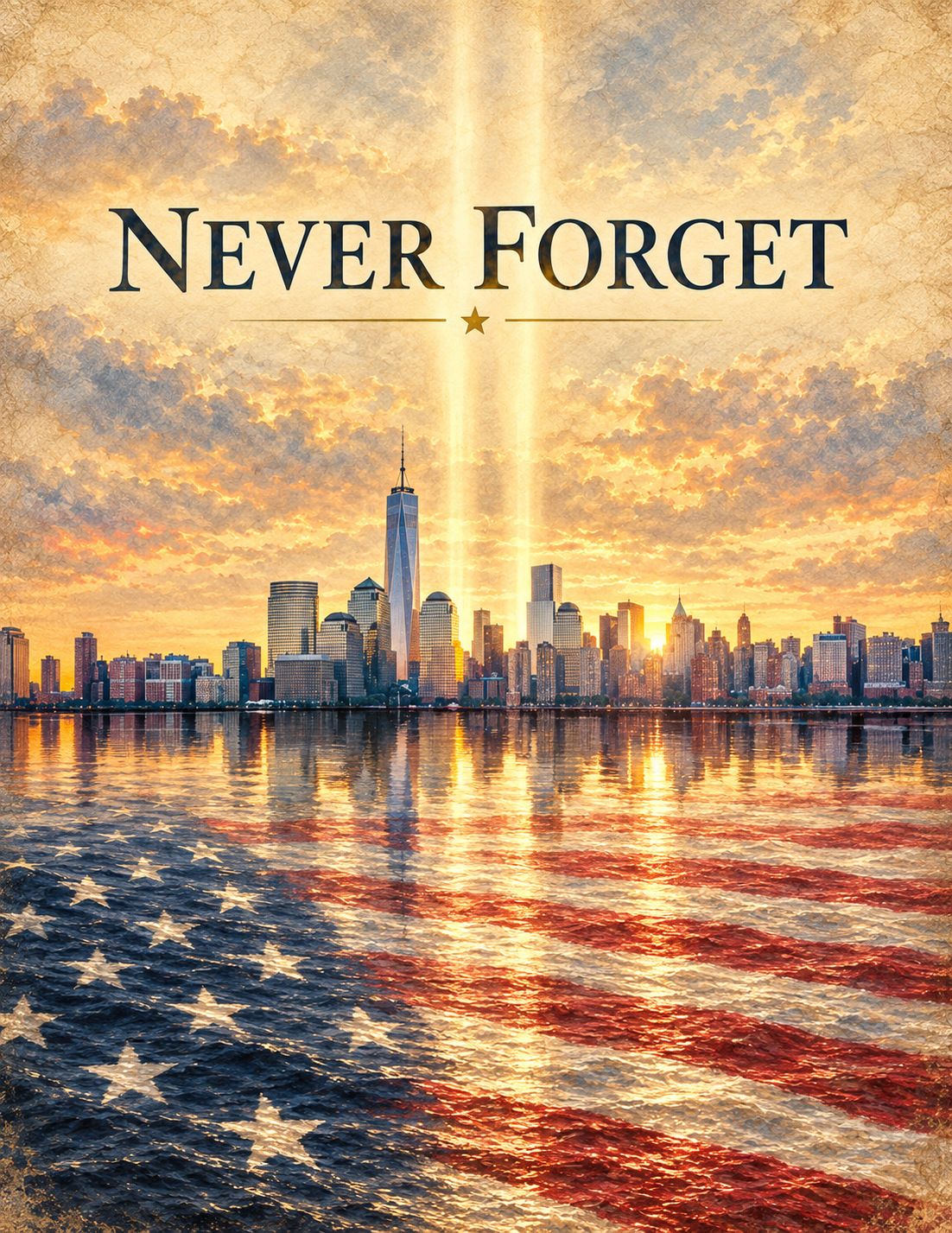
From the September 11, 2026 inaugural issue of The Colorado Conservative.
Twenty-five years after the attacks, the names remain the center of the story.
Whenever I begin an article about September 11, I seem to start from a place of anger. I cannot help it. Every fiber of my being wants to lash out at anyone I can remotely blame for that horrific day. Something about the twenty fifth anniversary has made that anger sharper. The passage of time feels more poignant this year. The somberness is deeper. Somehow, after a quarter century, it feels personal again.
Perhaps that is because twenty-five years is long enough for memory to become history. Children born after the attacks now teach school, raise families, wear badges, and deploy overseas. There are adults who know the Twin Towers only from photographs. Those of us who remember the day are becoming witnesses for those who do not.
Memory carries an obligation. We owe the dead more than a softened story. We owe them the truth about who attacked us, what happened in the aircraft and buildings, how ordinary people answered, and what our country did with its grief and fear. We also owe them reverence. The number 2,977 is accurate, but it is not adequate. A number cannot show the empty chair at a family table, the final telephone call, the firefighter climbing while everyone else descended, or the years of illness endured by those who ran toward the ruins.
September 11 was a terrorist attack planned by al-Qaeda and carried out by nineteen hijackers. It was not an accident, an abstraction, or a tragedy without human authors. The terrorists chose passenger aircraft because they could turn ordinary instruments of American life into weapons. They chose prominent national symbols and filled the morning with innocent people. Their aim was mass murder, fear, spectacle, and political shock.
They achieved destruction on a scale almost impossible to comprehend, but they did not destroy the American capacity for courage.
A clear September morning
Tuesday, September 11, 2001, began with a nearly cloudless sky over the eastern United States. People packed lunches, hurried children toward school, boarded commuter trains, settled into office chairs, and complained about traffic. At Boston Logan International Airport, Washington Dulles International Airport, and Newark International Airport, travelers boarded four flights bound for California. The long routes meant the aircraft carried large quantities of fuel.
American Airlines Flight 11 departed Boston for Los Angeles at 7:59 a.m. United Airlines Flight 175 followed from Boston at 8:14. American Airlines Flight 77 left Dulles at 8:20, bound for Los Angeles. United Airlines Flight 93 departed Newark at 8:42, forty-two minutes behind schedule, for San Francisco.
There were 246 passengers and crew aboard the four aircraft, excluding the hijackers. They included business travelers, grandparents, young children, flight attendants, pilots, military personnel, and people heading home. At the World Trade Center, tens of thousands began another workday. Across the Potomac, civilian and military employees entered the Pentagon.
The day still belonged to ordinary life. Then the first aircraft stopped answering normally.
Shortly after 8:14, the hijackers seized Flight 11. Flight attendants Betty Ong and Amy Sweeney used airphones to report what they could: people had been stabbed, the cockpit was not responding, and something was terribly wrong. Their calm work gave the country some of its first information about the attack. On the ground, controllers and airline employees tried to understand an event for which their systems and assumptions were not prepared.
At 8:46:40, Flight 11 struck the North Tower of the World Trade Center between floors 93 and 99.
The impact tore through the building and ignited thousands of gallons of jet fuel. The people above the impact zone were trapped. Stairwells were severed. Smoke climbed. Paper drifted into the clear sky. Television cameras turned toward lower Manhattan. Many viewers assumed they were witnessing a terrible aviation accident. Inside the South Tower, announcements initially told some occupants that the building was secure and that they could return to their offices. Many left anyway. That choice saved lives.
At 9:03:11, Flight 175 struck the South Tower between floors 77 and 85. Millions watched it happen live.
In that instant, uncertainty ended. America was under attack.
Inside the towers
The World Trade Center was not merely a pair of famous buildings. It was a workplace and a crossroads. Bankers and brokers worked near restaurant employees, maintenance crews, public servants, security officers, technicians, and visitors from around the world. The victims represented more than ninety nations. They were bound together that morning by location and fate.
Below the impact zones, the stairways became rivers of people. Some survivors remember strangers holding doors, offering water, carrying injured coworkers, and telling one another to keep moving. Evacuation was not perfectly orderly, but neither was it the blind panic so often imagined in disaster. Much of it was disciplined, patient, and humane.
First responders moved against the current. Firefighters climbed carrying heavy equipment. Police officers and Port Authority personnel directed civilians toward safety. Emergency medical workers established triage areas that would soon be overwhelmed or destroyed. Building staff searched floors. Civilians returned for colleagues.
At 9:59, after burning for fifty-six minutes, the South Tower collapsed.
The building descended in seconds. Streets became dark tunnels of dust and debris. Radio channels filled with calls that could not all be answered. People ran without knowing which direction was safe. Others sheltered behind vehicles or inside buildings. The collapse killed civilians who had not escaped and responders who were still climbing, searching, treating, and directing.
The North Tower remained standing for another twenty-nine minutes. People continued to leave from the lower floors. Responders continued their work. At 10:28, after burning for 102 minutes, it collapsed too.
The skyline changed, but the human loss was far more terrible. At the World Trade Center and the surrounding area, 2,753 people were killed, including 343 members of the Fire Department of New York, 23 New York City police officers, 37 Port Authority police officers, and other responders. No one in or above the impact zones of the North Tower survived. In the South Tower, eighteen people escaped from above the impact zone through Stairwell A.
There were also extraordinary survivals. People emerged from stairwells and rubble. Port Authority employees helped guide thousands out. The last known survivor pulled alive from the debris, Genelle Guzman-McMillan, was rescued after approximately twenty-seven hours. Their survival does not lessen the horror. It shows the narrow line that separated life and death that morning and the days after.
The Pentagon
While New York burned, Flight 77 disappeared from normal radar tracking and turned back toward Washington. At 9:37:46, it struck the western side of the Pentagon.
The Pentagon is the headquarters of the Department of Defense, but the people inside were not symbols. They were individuals at work. The crash and fire killed all 59 passengers and crew aboard the aircraft, excluding the hijackers, and 125 people in the building. The dead included military personnel and civilian employees. Some were only weeks from retirement. Some had survived earlier wars. Some had children waiting for them at home.
The recently renovated section of the building had structural improvements that helped limit the collapse and gave many occupants time to escape. Survivors crawled through smoke and broken offices. Coworkers formed human chains and carried the injured. Military officers, civilian employees, firefighters, police officers, and medical crews entered dangerous spaces to bring others out.
Pentagon survivor Kathy Dillaber later recalled the force of the impact, the darkness, and the struggle to escape. Her sister, Patricia Mickley, was killed only yards away. That closeness captures something a casualty table cannot: survival could mean carrying gratitude and grief in the same heart for the rest of a life. Destroying a family with mere feet separating outcomes.
The revolt aboard Flight 93
Flight 93 took off late, and the delay changed history. By the time hijackers seized it at about 9:28, passengers and crew could telephone people on the ground. They learned that aircraft had struck the World Trade Center. They understood that their own plane was part of the same attack and that complying with the hijackers would not save them.
The passengers and crew gathered information, voted, and acted. Their recorded calls contain love, fear, prayer, and resolve. Todd Beamer, Tom Burnett, Jeremy Glick, Mark Bingham, Honor Elizabeth Wainio, flight attendants Sandra Bradshaw and CeeCee Lyles, and others became known through fragments of those final conversations. No single name contains the whole revolt. It was a collective decision by people who understood the cost.
At 9:57, they began their counterattack. The hijacker at the controls rocked and rolled the aircraft while the passengers fought toward the cockpit. At 10:03:11, Flight 93 crashed into a field near Shanksville, Pennsylvania, at high speed. All 40 passengers and crew, excluding the hijackers, were killed.
The hijackers did not reach their intended target. The 9/11 Commission concluded that the target was probably the United States Capitol or the White House. The terrorists were determined to cause the maximum damage possible to our morale, economy, safety, and security, but because the people aboard Flight 93 acted, no other building was struck and no additional lives on the ground were taken.
They had no assurance that they could survive. In fact, the opposite had been all but confirmed. They moved anyway. Their courage belongs at the center of the American telling of September 11. In their final moments, they chose to be heroes. The American spirit endured as civilians declared they would not allow the monsters to accomplish their objective.
The nation in suspension
At 9:42, the Federal Aviation Administration ordered all civilian aircraft in the United States to land at the nearest airport. It was an unprecedented ground stop. Controllers brought thousands of aircraft down safely. Flights approaching the United States were diverted, many to Canada, where communities opened schools, churches, halls, and homes to stranded travelers.
In Washington, federal buildings were evacuated. Rumors outran confirmed facts. Government leaders moved to secure locations. Military aircraft patrolled American skies. At schools and workplaces, people crowded around televisions or tried telephone networks that could not carry the load. The world was living forever in a day, all while holding our breath.
The numbers began to come in. Names slowly trickled across the screens. The images were more gut-wrenching as time passed. The attacks killed 2,977 victims at the three sites, excluding the nineteen hijackers. The youngest was two and a half years old. The oldest was eighty-five. More than 400 of the dead were first responders. Thousands were injured. Countless others inhaled the dust that rolled through lower Manhattan, a toxic mixture of pulverized concrete, glass, metals, insulation, and the remains of buildings and lives.
The day did not end when the cameras lost the light. Fires burned at Ground Zero for months. Families carried photographs to hospitals and gathering places. Lists of the missing grew. Rescue workers dug through a landscape that seemed beyond rescue. Priests, counselors, construction workers, ironworkers, engineers, doctors, nurses, volunteers, and search teams arrived. Across the country, people stood in line to give blood. Churches, synagogues, mosques, and public squares filled with prayer and grief.
Many families received no identifiable remains. For them, absence itself became the wound. Pure, unadulterated evil had struck and taken a piece of the American heart with it.
The day after and the week that followed
On September 12, smoke still rose from Manhattan and the Pentagon. The scale of the loss was not yet fully known. Across the Atlantic, NATO declared that if the attack had been directed from abroad, it would fall under Article 5 of the North Atlantic Treaty, treating an attack on one ally as an attack on all. Europe shuttered at the thought and the world watched with its own bated breath as the most powerful alliance in human history sought a target to launch its entire fury upon. When the foreign direction of the plot was confirmed, NATO officially invoked Article 5 for the first and only time in its history.
Expressions of solidarity came from allies, rivals, and ordinary people across the world. Vigils formed in European capitals. The French newspaper Le Monde carried the declaration that all were Americans. Queen Elizabeth II authorized the playing of the United States national anthem during the changing of the guard at Buckingham Palace. In Canada, communities cared for thousands of diverted passengers. For a short time, the world stood very close to the United States.
At home, members of Congress gathered on the Capitol steps and sang together. President George W. Bush visited Ground Zero on September 14. Standing on wreckage with his arm around retired firefighter Bob Beckwith, he responded to workers who could not hear him: the people who had knocked down the buildings would soon hear from America. They would hear the full, unabridged resolve of an America that was unified by grief.
That week revealed the country at its best. Americans displayed flags, donated, volunteered, worshiped, and checked on neighbors. Political divisions did not disappear, but they became small beside the open grave in lower Manhattan, the chaotic rubble at the Pentagon, and the smoldering ruins in a Pennsylvania field.
The week also revealed how fear can widen the circle of injury. Muslim, Arab, Sikh, and South Asian Americans faced harassment, vandalism, discrimination, and violence from people who treated ancestry, clothing, or faith as guilt. Balbir Singh Sodhi, a Sikh American in Arizona, was murdered on September 15 by a man who said he wanted revenge for the attacks. The terrorists were al-Qaeda extremists. American neighbors were not responsible for their crime, but the full damage from this heinous act was going to stretch much farther and wider than the sorrow that had already been inflicted.
From grief to war
Congress passed the Authorization for Use of Military Force on September 14, empowering the president to use force against those who planned, authorized, committed, or aided the attacks, and those who harbored them. The United States and its allies began military operations in Afghanistan on October 7. The immediate purpose was to dismantle al-Qaeda and remove the Taliban regime that had given it sanctuary. Our determination for vengeance and the need to calm a frightened populous came with a terrible fury.
American forces and their partners drove the Taliban from national power quickly, but the war did not end. It expanded into a long counterinsurgency and nation building effort. Osama bin Laden escaped Afghanistan and was finally killed by United States forces in Pakistan in 2011. The war in Afghanistan continued until the American withdrawal in 2021 and immediately the Taliban returned to power. This may be one of the reasons this anniversary feels so painful. The work we did to liberate a country and eliminate the perpetrators of 9/11 seemed meaningless when in a single day we ran from the country, tail tucked firmly, and the 20-year transformation of Afghanistan and the many lives lost to get to that point were undone instantly.
Now the broader War on Terror reshaped United States policy far beyond Afghanistan. It produced new intelligence and military operations, detention at Guantanamo Bay, debates over torture and due process, drone warfare, and a security architecture designed around threats that crossed borders and did not wear uniforms. Trust became shaky. Then we invaded Iraq.
The human cost of the wars was enormous. American service members were killed and wounded. Military families endured repeated deployments and long separations. Afghan and Iraqi civilians suffered death, displacement, and instability. Veterans returned with visible injuries and many wounds that could not be seen. The fiscal cost reached into the trillions of dollars. Some operations disrupted terrorist networks and prevented plots; some decisions created new grievances, instability, and hard questions that remain unsettled.
September 11th demanded a response. It did not, however, guarantee that every response made in its’ name would be successful.
The Patriot Act and the price of urgency
The single largest paradigm shift in American legislation materialized overnight. The USA PATRIOT Act became law on October 26, 2001, forty-five days after the attacks. Its title was an acronym for Uniting and Strengthening America by Providing Appropriate Tools Required to Intercept and Obstruct Terrorism. It passed the Senate 98 to 1 and the House 357 to 66. The speed and margins reflected a country that believed another attack might be imminent.
The law addressed genuine failures exposed by 9/11. Before the attacks, legal and institutional barriers had limited the exchange of information between intelligence and criminal investigators. Agencies held pieces of the threat without assembling the picture. The Patriot Act made it easier to share information, follow money, investigate terrorist financing, pursue roving wiretaps that followed a suspect rather than a single telephone, and update investigative authorities for an era of email and mobile communication. Supporters credit these tools, alongside later reforms, with improving coordination and helping authorities disrupt terrorist activity.
Several provisions were less novel than public debate sometimes suggests. Roving wiretaps and delayed notice searches already existed in other criminal contexts. Bringing comparable tools into terrorism investigations had a defensible purpose. The government cannot protect a free nation if investigators are forced to use rules built for technologies and organizational boundaries that had been horrifically shattered.
But urgency compressed deliberation, and broad powers seldom remain confined to the emergency that produced them.
Section 215 allowed the government to seek orders from the Foreign Intelligence Surveillance Court for business records and other tangible things relevant to authorized national security investigations. Years later, the public learned that the government had interpreted this authority to support bulk collection of domestic telephone metadata. National security letters expanded access to certain records and often carried nondisclosure requirements. Other provisions widened surveillance, information sharing, and delayed notification of searches.
The objections were not objections to fighting terrorism. They concerned scale, secrecy, judicial review, and the constitutional presumption that government should have a particular reason to examine a person's private life. Secret interpretations prevented meaningful public debate. Gag orders limited the ability of recipients to speak. Broad collection placed the records of people suspected of no wrongdoing within government reach. Powers written for national security could bleed into ordinary criminal investigations.
Oversight eventually changed parts of this system. In 2015, the United States Court of Appeals for the Second Circuit held that Section 215 did not authorize the bulk telephone records program as operated. Congress then enacted the USA FREEDOM Act, which ended government bulk storage of those call records under that authority and imposed additional limits and transparency measures. Several Patriot Act authorities later expired, though other surveillance and national security powers remain in law.
The Patriot Act's record is therefore neither a simple triumph nor a simple betrayal. Better information sharing and modern investigative tools answered real vulnerabilities. Excessive secrecy and indiscriminate collection threatened the privacy and limited government the nation was defending. Both truths can stand together.
The enduring lesson is that emergency power requires boundaries, independent review, public accounting where possible, and expiration dates that force Congress to reconsider what it authorized. Fear may explain why a government acts quickly. It cannot be the permanent standard by which free people are governed.
The permanent changes
The most visible legacy appears every time Americans fly. Congress created the Transportation Security Administration in November 2001. Reinforced cockpit doors, federal screening, watch lists, restrictions on carry-on items, and new passenger procedures made the airport checkpoint part of ordinary life. Before 9/11, hijacking doctrine often assumed that passengers would be held for negotiation. Flight 93 ended that assumption. Passengers and crews now understand that a seized aircraft may itself be the weapon.
The federal government created the Department of Homeland Security in 2002, combining 22 agencies and offices. Intelligence coordination changed. State and local governments built fusion centers and expanded emergency planning. Police, fire departments, hospitals, schools, businesses, and infrastructure operators revised their plans for terrorism and mass casualty incidents. Buildings changed access controls. Public spaces added barriers and cameras. The vocabulary of daily life acquired homeland security, threat levels, active threats, and see something say something.
The effects reached far beyond security policy. The attacks influenced immigration enforcement, foreign aid, banking rules, international data sharing, journalism, entertainment, architecture, and public attitudes toward risk. They altered elections and presidential power. They contributed to a generation's distrust of institutions when official claims later proved incomplete, secret programs became public, or wars lasted far longer than promised.
They also left a public health disaster. Responders, recovery workers, survivors, residents, students, and office workers were exposed to toxic dust and smoke. In later years, many developed cancers, respiratory diseases, digestive disorders, and mental health conditions. Congress established and repeatedly reauthorized the World Trade Center Health Program and the September 11th Victim Compensation Fund. The rolls of those who have died from 9/11 related illness continue to grow. For thousands, September 11 did not last one morning. It entered their lungs and followed them for decades.
Children lost parents. Parents buried children. Firehouses lost entire groups of men who had eaten, trained, argued, and laughed together. Survivors built lives around an absence. Some carried guilt because they lived. Others found purpose in advocacy, service, memorial work, or caring for fellow responders.
The attacks also became a dividing line in time. Americans began saying before 9/11 and after 9/11 because ordinary language needed a border. The years before acquired an innocence they may not have fully possessed. The years after carried permanent vigilance.
Anger and the truth
From the moment the first plane struck the North Tower, our world was never going to be the same. A nation accustomed to freedom, prosperity, and relative safety encountered something bitter and primal. We had lived as though our future was guaranteed, as though distance and power placed catastrophe somewhere else. A symbol of that confidence came crashing down, and the cold breath of reality creeped down our necks.
Our country had spent generations struggling, sacrificing, and arguing toward a fuller meaning of its founding promises. We were not perfect. We had never been perfect. Yet many Americans remember a greater willingness to trust a neighbor, a public institution, or the basic peace of an ordinary morning. When the towers fell, that confidence fractured.
In the same period, the Patriot Act was born, an enemy was declared, and the War on Terror began. The campaign would outlast a single enemy, a single mastermind, and a single mission. It became a governing creed with consequences across generations. We fought terrorists, but we also fought our own fear, and fear appeared in our politics, our laws, our wars, our airports, and the ways we looked at one another.
This is what angers me. We were flung from sweet innocence into a battle against an enemy whose most effective weapon was fear. Anger helped create the hateful ideology behind the attacks, and anger shaped too much of what followed. Anger asks for an object. Grief does not always provide one. So anger can travel outward, striking the guilty, the innocent, our institutions, our neighbors, and eventually ourselves.
But anger is not the only inheritance of September 11th.
What remained in the box
In the deepest core of that pain, there was a glimmer of light. I always arrive there by the time I finish writing about September 11.
It is easy to remember every horrific aspect of that day, but there is one thing that often gets forgotten: Despite the unlikeliness of it happening, America came together. The whole country united, however briefly, because we recognized the same wound. Firefighters climbed. Police officers held stairwell doors. Flight attendants reported what they saw. Office workers carried strangers. Passengers voted to fight. Ironworkers cut steel. Neighbors opened their homes. Americans lined up to give blood. People prayed in many languages for people they had never met.
For one single, hauntingly beautiful moment, our bitter bickering became quiet enough for us to hear the names of the dead and see the bonds between our fellow Americans.
The unity did not last. Perhaps no unity born in catastrophe can. Political arguments returned, then hardened. Wars divided us. Fear enlarged government. Distrust grew. The attacks became history, then rhetoric, then an image shown to people too young to remember the sounds, smells, and sorrows of that morning.
Yet the fact that unity faded does not make it false. It reveals a significant capacity that still resides within us all. We must choose to tap into it.
The memorials at New York, the Pentagon, and Shanksville do not ask visitors to admire destruction. They return us to individual lives. At the National September 11 Memorial, water falls into the footprints of the towers beside bronze panels bearing names. At the Pentagon Memorial, 184 illuminated benches mark those killed in the building and aboard Flight 77. In Pennsylvania, the Flight 93 National Memorial follows the final path of the aircraft and honors forty passengers and crew members who acted together.
The names are the answer to abstraction. They remind us that nations are made of people, that policy has human consequences, and that courage is usually a decision made by an ordinary person before anyone knows how the story will end.
Whenever Pandora's box was opened in the old story, suffering escaped into the world, but hope remained. On September 11, hatred opened a new chamber of grief. Fear, war, illness, suspicion, and overreach followed. Hope remained too, carried by people who chose duty over safety, love over hatred, and courage over fear.
Twenty-five years later, remembrance requires more than anger. It requires us to defend the country without surrendering its character, to give government the tools it truly needs without granting power beyond review, to name the enemy without condemning the innocent, and to tell the next generation what happened without turning human beings into dispassionate statistics.
Most of all, it requires us to remember the victims as they lived, not only as they died.
On this anniversary, we should allow ourselves to feel the pain. We should allow the anger to speak, but not to rule. Then we should listen for what remains beneath it: the determination to protect one another, the humility to learn from failure, and the hope that a wounded people can still choose to be united.
We must never forget.
Sources and factual foundation
This article draws principally from the Final Report of the National Commission on Terrorist Attacks Upon the United States; the National September 11 Memorial and Museum's historical resources and oral history collection; the Flight 93 National Memorial and National Park Service; the Pentagon Memorial; the text and legislative history of the USA PATRIOT Act and USA FREEDOM Act; decisions and oversight concerning Section 215; NATO's official history of its Article 5 response; and federal records concerning the World Trade Center Health Program and September 11th Victim Compensation Fund.