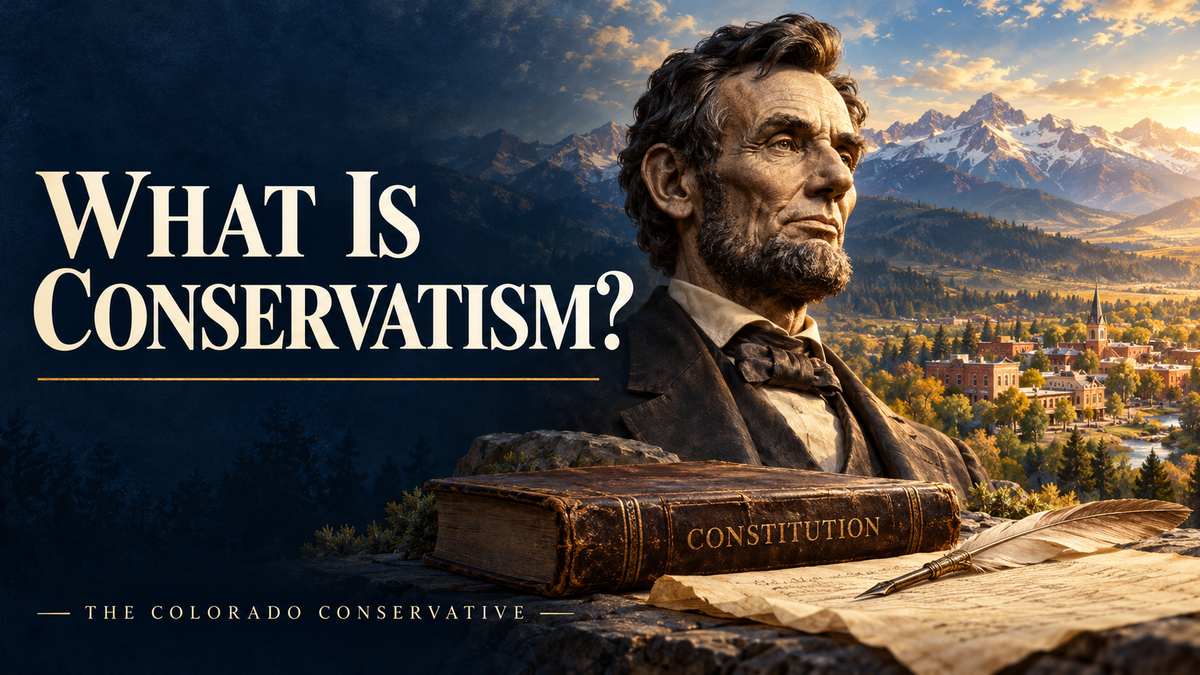
What Is Conservatism?
The origins of conservatism, its American inheritance, Abraham Lincoln, and a path toward national prosperity.

From the September 11, 2026 inaugural issue of The Colorado Conservative.
Its origins, its American inheritance, the age of Abraham Lincoln, and a path toward national prosperity
By Eric Phelan
Conservatism is not a promise to preserve everything. It is a duty to preserve what makes freedom possible.
The Work of Conserving a Free Nation
Conservatism begins with a question that every generation must answer: What have we inherited that is worth preserving, and what must we repair so that the inheritance can endure? It is not simply resistance to change. It is a philosophy of ordered liberty - a belief that freedom survives when it is protected by law, disciplined by responsibility, supported by strong families and communities, and restrained by institutions that no temporary majority may casually sweep aside.
At its best, conservatism combines gratitude with judgment. It recognizes that a nation is more than a government program, an election result, or a collection of isolated individuals. A nation is a living compact among generations. Its citizens receive a constitutional order, a body of law, a culture, public institutions, accumulated knowledge, and obligations they did not invent. They are not forbidden to change these things. They are entrusted to improve them without destroying the foundations on which future freedom depends.
This is why conservatism is neither nostalgia nor reaction. Nostalgia romanticizes the past; reaction tries to reverse history. Conservatism asks harder questions; Which traditions carry wisdom? Which customs protect human dignity? Which institutions disperse power? Which injustices contradict the very principles a nation claims to conserve?. Genuine conservatism can defend an old institution, reform it, or abolish it. The test is not age alone. The test is whether that institution serves truth, justice, liberty, and the long-term health of the country.
American conservatism adds a distinctive answer: the central inheritance to be conserved is a constitutional republic dedicated to natural rights and self-government. That inheritance includes limited powers, federalism, representative government, due process, religious liberty, property rights, free speech, equal citizenship, and a civil society strong enough to do work that government neither can, nor should control. American conservatives may disagree sharply about policy, but without these commitments the word becomes little more than a political label.
The Origins of Conservative Thought
Human beings have always valued continuity, custom, authority, and inherited wisdom. Conservatism as a self-conscious political tradition, however, emerged in response to the upheavals of the late eighteenth century, especially the French Revolution. The revolution did not merely remove a government. Its most radical leaders attempted to rebuild political and social life from abstract principles, sweeping away established institutions and treating inherited loyalties as obstacles to a perfected society.
Edmund Burke, an Irish-born British parliamentarian, supplied the classic conservative answer in Reflections on the Revolution in France, published in 1790. Burke was no defender of every abuse. He had supported conciliation with the American colonies and criticized abuses of imperial power. His central warning was about method: a society cannot safely be reconstructed as if it were a machine whose parts are fully understood. Institutions often contain knowledge accumulated through experience - knowledge no committee could design from the beginning. Reform is necessary, but prudent reform works with the grain of human nature and lived experience.
Burke's conservatism rested on several enduring ideas. Human reason is real but limited. Power must be restrained because people are imperfect. Freedom requires order, habit, and moral responsibility. Property gives citizens independence and encourages stewardship. Associations between the individual and the national government - families, churches, neighborhoods, charities, businesses, and local governments - are not inconveniences to be bypassed; they are where citizens learn cooperation, duty, and self-command. Change should ordinarily be gradual enough to reveal unintended consequences before they become national disasters.
This tradition is sometimes caricatured as blind obedience to the past. Burke's own formulation defeats that caricature: a state without the capacity for change lacks the capacity to preserve itself. Conservative reform therefore resembles repair. It starts by understanding what a structure does, which walls bear weight, and why earlier generations built it as they did. It then corrects failure while preserving what still works. That approach can be slower than revolutionary politics, but it is also less likely to make ordinary people unwilling subjects of a grand experiment.
Conservatism differs from libertarianism, though the two often overlap. Libertarian thought begins with individual freedom and is especially suspicious of coercion. Conservatism also values liberty, but it places greater emphasis on inherited obligations, community, virtue, public order, and the cultural conditions that make liberty sustainable.
Conservatism also differs from authoritarianism. A conservative respect for authority is not a blank check for rulers. Legitimate authority is limited by law, custom, constitutional structure, and the rights of persons. A government that destroys these restraints is not conserving order; it is replacing order with power.
The American Inheritance
The American founding predated conservatism as a named ideology, yet it joined revolutionary claims about natural rights to a deeply conservative understanding of power. The Declaration of Independence announced universal principles: human equality, unalienable rights, government by consent, and the people's right to alter a government that becomes destructive of its purposes. The Constitution then built a durable framework for exercising that liberty without surrendering the nation to disorder or concentrated power.
The Constitution assumes that good intentions are insufficient. Legislative, executive, and judicial powers are divided. The national government possesses enumerated powers rather than unlimited jurisdiction. States retain their own authority. Elections permit correction without revolution. A bicameral legislature slows decision-making. Courts apply law. The amendment process allows deliberate change. James Madison's argument in Federalist No. 51 - that institutional ambition must check ambition - reflects a conservative realism about human nature. Liberty is protected not by trusting leaders to remain virtuous, but by arranging government so that power encounters power.
The Bill of Rights strengthens this architecture by placing vital liberties beyond ordinary political convenience. Speech, worship, assembly, due process, protection from unreasonable searches, the right to keep and bear arms, and other guarantees do more than protect favored groups. They protect dissenters, minorities, and unpopular citizens when majorities are least inclined to do so. Constitutional conservatism is therefore not ruled by whichever faction wins the latest election. It is majority rule bounded by law and individual rights.
The founding also contained a devastating contradiction. A nation proclaiming human equality tolerated and protected slavery. That contradiction matters to an honest account of American conservatism. It demonstrates why conserving a nation's principles may require rejecting practices that are old, profitable, and legally entrenched. The founding ideals were not invalid because the founding generation failed to fulfill them. They became the standard by which later Americans could expose that failure.
The Age of Abraham Lincoln
Abraham Lincoln is indispensable to understanding the American conservative tradition, although applying today's political labels to the 1850s can mislead. Lincoln was formed in the Whig tradition. He favored economic development, internal improvements, commerce, education, and the upward mobility of free labor. He revered the Constitution and the Union. At the same time, he opposed the spread of slavery and treated the Declaration of Independence as the moral center of the American experiment.
The Republican Party arose in the 1850s from former Whigs, antislavery Democrats, Free Soilers, and others united primarily against the extension of slavery into federal territories. Its 1856 platform explicitly joined the Declaration's principles to the preservation of the Constitution, the rights of the states, and the Union. That combination is important. The early Republican case was not presented as a demand to discard the founding order. It was presented as a demand to restore the government to the founding principles that slavery's expansion betrayed.
Lincoln made this argument with special force at Cooper Union in 1860. After examining the conduct of those who framed the Constitution, he argued that federal restriction of slavery in the territories was consistent with their practice. His purpose was conservative in method: he answered the charge of radicalism by appealing to constitutional history, precedent, and the intentions of the founding generation. Yet the moral consequence was profound. Fidelity to the nation's oldest promises required resistance to a powerful and deeply rooted injustice.
Lincoln's earlier Lyceum Address also revealed a central part of his political character. Confronted by mob violence, he warned that contempt for law could become a greater danger than any foreign army. He called for reverence for the Constitution and laws, while also recognizing that bad laws should be repealed through lawful processes. This is ordered liberty in its clearest form: law is not sacred because every statute is just, but lawful self-government is the means by which a free people corrects injustice without descending into vengeance or arbitrary rule.
The Civil War placed these principles under almost unbearable strain. Lincoln's first constitutional duty was preservation of the Union. As the war developed, emancipation became both a military measure and a fulfillment of the nation's moral logic. The Emancipation Proclamation did not by itself end slavery everywhere, but it transformed the war and authorized Black enlistment in the Union cause. The Thirteenth Amendment abolished slavery. The Fourteenth Amendment, adopted after Lincoln's death, established national birthright citizenship, equal protection, and due process against state governments. The Fifteenth Amendment prohibited racial discrimination in voting rights for men.
These achievements also expose conservatism's recurring danger. Appeals to local authority, tradition, property, or social order can become defenses of injustice when separated from natural rights and equal citizenship. The Reconstruction amendments did not abandon the Constitution; they corrected and completed it. Lincoln's example teaches that prudence is not passivity, reverence is not denial, and national unity cannot be purchased by permanently excluding some Americans from the nation's promise.
Lincoln therefore represents a conserving statesmanship that is both rooted and reforming. He did not treat the country as a blank slate. He drew authority from the Declaration, the Constitution, the founding generation, elections, Congress, military necessity, and the amendment process. He sought to preserve the Union while changing the legal order that had made the Union's crisis unavoidable. His politics remind conservatives that the object of preservation is not every arrangement inherited from the past. It is the constitutional republic and the equal human dignity that gives the republic its moral legitimacy.
The Rise of Modern American Conservatism
Modern American conservatism took recognizable form in the middle of the twentieth century. The growth of the federal government during the New Deal, the rise of Soviet communism, expanding administrative power, changing social norms, and debates over religion and education brought several groups into an uneasy coalition. Traditionalists defended moral order and inherited institutions. Free-market advocates defended private property and economic liberty. Anticommunists emphasized national strength and the defense of the West. Later, religious conservatives mobilized around family, life, education, and religious freedom.
William F. Buckley Jr. and National Review, founded in 1955, helped give this coalition a common language and an intellectual home. Frank Meyer became associated with 'fusionism,' an effort to reconcile traditional moral commitments with political liberty and free markets. Barry Goldwater's 1964 presidential campaign lost decisively, but it organized activists, clarified limited-government arguments, and prepared the way for a broader conservative movement.
Ronald Reagan became the movement's most effective national communicator. In his 1964 address A Time for Choosing, he framed the conflict around human dignity, personal choice, fiscal responsibility, and resistance to totalitarian power. As president, he joined tax reduction and deregulation to a military buildup, anticommunist foreign policy, and a renewed language of national confidence. The modern conservative coalition reached beyond one region and helped make conservatism a governing force rather than a permanent opposition.
Its record, like the record of every governing movement, was mixed. Market reforms and entrepreneurial confidence contributed to growth and innovation, but federal spending and debt remained persistent problems. Conservatives celebrated federalism yet sometimes favored national power for causes they supported. They defended constitutional restraint while occasionally yielding to executive power. The movement included principled constitutionalists, libertarians, traditionalists, religious voters, foreign-policy hawks, economic nationalists, and populists whose priorities did not always fit together.
The first quarter of the twenty-first century intensified those tensions. Globalization produced great wealth and technological progress but also dislocated communities and concentrated opportunity. The attacks of September 11, long wars, the financial crisis, rapid cultural change, a pandemic, border disorder, distrust of institutions, and the rise of digital platforms altered conservative politics. A newer populist current challenged establishment failures, emphasized borders, trade, sovereignty, and working-class interests, and rejected the assumption that every market outcome or international commitment automatically served the national interest.
The modern conservative is therefore not reducible to one demographic, denomination, region, or policy faction. A coherent modern conservatism can include free enterprise without corporate favoritism, patriotism without hostility to criticism, secure borders without contempt for immigrants, strong defense without careless intervention, religious conviction without state-imposed faith, and public order without indifference to equal justice. The coalition will remain broad only if it remembers the principles that justify its power.
What Conservatism Is Not
Conservatism is not the belief that government can do nothing. The Constitution itself assigns government essential duties: defending the nation, enforcing law, securing rights, maintaining courts, regulating matters placed within federal jurisdiction, and providing the stable rules under which free people can cooperate. The conservative question is not whether government acts, but whether it possesses the authority, competence, accountability, and institutional limits to act well.
Conservatism is not automatic loyalty to business. Competitive enterprise can expand opportunity, but monopolies, regulatory capture, subsidies, and political favoritism corrupt markets. A conservative economy rewards work, risk, saving, invention, and honest exchange. It does not privatize profit while transferring loss to taxpayers.
Conservatism is not personal loyalty to a political leader. The American system was built to prevent any person from becoming the state. Leaders must be judged by constitutional conduct, results, character, and fidelity to the people they serve. A movement that excuses in its own champions what it condemns in its opponents ceases to be principled.
Conservatism is not refusal to acknowledge national failure. Patriotism includes gratitude for the country, loyalty to its constitutional order, and determination to correct its wrongs. Honest history does not weaken America. It prevents national memory from becoming propaganda and allows achievement to be admired without concealing injustice.
Finally, conservatism is not a purity test. Principles matter precisely because they guide disagreement. A durable governing movement must distinguish fundamental commitments from policy judgments on which people of good faith can differ. Coalition does not require intellectual surrender. It requires enough humility to persuade, enough discipline to govern, and enough confidence to welcome allies who arrive by different roads.
A Conservative Path to Prosperity
Prosperity is more than a rising stock market or a larger gross domestic product. A prosperous nation enables families to afford homes, workers to gain skills and higher wages, entrepreneurs to start firms, communities to remain safe, children to receive serious education, and future generations to inherit sound finances and functioning institutions. Material growth matters because scarcity is real, but the purpose of growth is human flourishing rather than accumulation alone.
A conservative path begins with the rule of law. Contracts must be enforceable, property secure, regulations intelligible, courts independent, and public officials accountable. Economic freedom depends on predictable rules. When policy changes according to political connections or bureaucratic whim, investment retreats and ordinary citizens pay the price. Constitutional stability is therefore an economic asset as well as a civic one.
Fiscal responsibility is equally necessary. Persistent borrowing shifts today's consumption onto tomorrow's workers and eventually limits the nation's choices. Conservatism should demand honest budgets, transparent liabilities, disciplined spending, effective programs, and the courage to reform commitments before crisis force harsher decisions. Taxation should raise necessary revenue as simply and as fairly as possible while preserving incentives to work, save, invest, and build.
Free enterprise should be defended as a system of open competition, not as a shield for favored incumbents. Government should remove barriers that protect entrenched interests, make it easier to start and expand a business, and ensure that rules apply equally. Education and workforce policy should create multiple honorable routes to success: universities, community colleges, apprenticeships, trades, military service, and employer-based training. A nation wastes talent when it treats a four-year degree as the only respectable path.
Federalism can restore both experimentation and accountability. States and local communities differ in geography, culture, resources, and needs. Decisions should be made close to the people unless the Constitution assigns them elsewhere or a genuine national problem requires national action. Local authority is not an excuse to violate constitutional rights. Properly understood, it allows diverse communities to test solutions, learn from one another, and replace failure without imposing it on the entire country.
Strong families and voluntary institutions are also foundations of prosperity. No tax credit can substitute for stable affection, no agency can fully replace a responsible parent, and no national bureaucracy can reproduce the knowledge of a healthy neighborhood. Public policy should stop penalizing marriage, work, caregiving, saving, and community service. Government should cooperate with civil society where appropriate without absorbing it or conditioning assistance on ideological conformity.
A forward-looking conservatism must also be capable of building. It should welcome scientific discovery, energy abundance, modern infrastructure, domestic production, advanced computing, and responsible development. Prudence does not mean technological fear. It means judging innovation by real benefits, real risks, security, property rights, environmental stewardship, and effects on communities. Conservatives should be the advocates of permitting reform and faster construction while insisting that costs are not quietly imposed on neighbors, ratepayers, farmland, water supplies, or future taxpayers.
National strength remains essential. Peace is more likely when the United States can defend itself, protect critical infrastructure, secure its borders, maintain reliable supply chains, and deter aggression. Strength, however, must be joined to judgment. A conservative foreign policy should identify concrete national interests, require achievable objectives, respect Congress's constitutional responsibilities, care for those sent into danger, and resist both isolation and open-ended intervention.
Immigration policy offers another test of ordered liberty. A sovereign nation has the right and duty to control its borders and enforce its laws. It also benefits from lawful immigration, welcomes people who embrace the American constitutional order, and should administer rules with clarity and humanity. Enforcement without a workable legal system produces recurring disorder; generosity without boundaries dissolves public consent. The conservative task is to restore both sovereignty and legitimacy.
None of these goals can survive a collapse of civic trust. Elections must be transparent and competently administered. Public records must be accessible. Officials must answer for failure. Citizens must be able to argue without treating political opponents as enemies to be destroyed. Schools should teach the nation's founding documents, achievements, failures, and constitutional methods of reform. Self-government requires citizens who know not only their rights but also the habits that keep those rights secure.
Conserving the Future
The deepest conservative insight is that civilization is difficult to build and easy to damage. Freedom depends on habits that laws alone cannot create: honesty, restraint, courage, tolerance, duty, work, gratitude, and care for people who cannot stand alone. Institutions depend on public confidence, and confidence depends on institutions proving worthy of it. Markets depend on trust. Constitutional government depends on citizens accepting limits even when power is within reach.
Yet conservatism should never speak as though America's best days exist only in memory. The purpose of conserving is to make renewal possible. The United States still possesses extraordinary advantages: a constitutional tradition, abundant resources, innovative people, deep capital markets, a culture of voluntary association, unmatched universities and trades, and millions of citizens who want to build useful lives. The task is to reconnect those strengths to responsibility and common purpose.
That will require conservatives to recover the difference between performance and governance. Anger can identify betrayal, but anger cannot balance a budget, educate a child, build a power plant, secure a network, repair a road, or restore confidence in a court. Governing demands competence, measurement, persuasion, and correction. It demands leaders who tell supporters when a promise is impossible, admit when a policy fails, and care more about durable results than momentary applause.
From Burke, conservatism inherits prudence and respect for accumulated wisdom. From the American founders, it inherits natural rights and constitutional restraint. From Lincoln, it learns that preservation can require moral courage and lawful transformation. From the modern movement, it inherits the defense of free enterprise, national strength, faith, family, and individual responsibility - together with warnings about debt, inconsistency, and coalition fracture.
Conservatism can lead America toward a prosperous future when it conserves the right things: liberty under law, equal citizenship, limited and competent government, open opportunity, strong communities, national sovereignty, and the moral dignity of the person. It must be steady without becoming stagnant, patriotic without becoming blind, and confident without becoming arrogant. Its proper mission is not to freeze the nation in an imagined golden age. It is to carry forward the tested inheritance of a free people, repair what has failed, and leave the republic stronger than we found it.
Notes and Sources
The following historical documents and scholarly references support the article and provide avenues for further reading.
1. Edmund Burke, Reflections on the Revolution in France, 1790. Project Gutenberg edition: https://www.gutenberg.org/ebooks/15679
2. Stanford Encyclopedia of Philosophy, Conservatism. https://plato.stanford.edu/entries/conservatism/
3. National Archives, Declaration of Independence, Constitution, and Bill of Rights. https://www.archives.gov/founding-docs
4. Library of Congress, Federalist Papers primary-source guide, including Federalist No. 51. https://guides.loc.gov/federalist-papers
5. The American Presidency Project, Republican Party Platform of 1856. https://www.presidency.ucsb.edu/documents/republican-party-platform-1856
6. Library of Congress, With Malice Toward None, including Lincoln's Cooper Union Address and the 1860 campaign. https://www.loc.gov/exhibits/lincoln/the-run-for-president.html
7. National Constitution Center, Abraham Lincoln's Lyceum Address, 1838. https://constitutioncenter.org/the-constitution/historic-document-library/detail/abraham-lincoln-speech-to-the-young-mens-lyceum-of-springfield-1838
8. National Archives, Emancipation Proclamation and Reconstruction Amendments. https://www.archives.gov/milestone-documents/emancipation-proclamation
9. Ronald Reagan Presidential Library, A Time for Choosing, October 27, 1964. https://www.reaganlibrary.gov/archives/speech/time-choosing-speech
10. National Review Institute, institutional history and statement of principles. https://nrinstitute.org/about-nri/