When Denver Threw a Mardi Gras
The story of Denver’s exuberant 1895 autumn festival and the spectacle that briefly transformed the city.

From the October 2026 issue of The Colorado Conservative.
Six weeks to hatch a plan and three days to turn Denver into a spectacle.
In 1895, Denver was in desperate need of a good day.
There were probably hundreds of reasons Denver needed a break, but by autumn, planners had gathered and a plot was being brewed.
It was the sort of plot that begins innocently enough with a meeting. Before long, however, the meeting was entertaining ambitions that would require a parade route and a royal court. Denver's next chapter was going to be considerably more colorful than its last.
The silver boom had helped sustain fortunes in the city, where merchants supplied the mines and railroads carried their business. Then the Panic of 1893 brought falling silver prices, bank failures, and a painful lesson in expecting a boom to go on forever. Recovery called for a broader foundation, including agriculture, manufacturing, and tourism. [1]
Major Hooper of the Denver and Rio Grande Railroad supplied an idea: Denver ought to have a signature festival modeled on New Orleans's Mardi Gras. For a railroad promoter, a celebration worth traveling to offered an agreeable combination of pleasure and passengers. [2]
The Chamber of Commerce, already promoting tourism as part of Denver's recovery, took up the opportunity to attract visitors and business. [1] Thus the plot thickened. There was a sensible purpose behind it, which is always useful when an ambitious idea begins requesting grandstands.
It was decided: The Festival of Mountain and Plain would take place October 16 through 18. The problem was, that was only six weeks away.
This was going to take some outside expertise. Before the denizens of Colorado knew it, a board and committees had assembled, women's clubs were engaged and busy working, and reinforcements had been called in from the Big Easy itself. Mardi Gras planners joined the effort, alongside costume designers and float builders, to help turn Denver's magnificent idea into something that could actually make it down a street. [3,4]
Six weeks to create the party of the century. October, displaying the appalling manners of a month with somewhere to be, refused to wait.
William N. Byers, founder and former owner of the Rocky Mountain News, helped oversee the undertaking. The city's story was about to require considerably more elbow room than a newspaper column. [4]
Even the title had to hurry up and settle in. Festival of Mountain and Plain began as a temporary name, but a contest failed to produce a replacement the organizers preferred. [3] It was a generous name, anyway, with room for the mining communities in the mountains and the farming towns on the plains.
Schools and civic groups prepared parade entries, businesses decorated, newspapers spread the invitation, and railroads advertised special fares. [3,4] A costume had to fit its wearer, a float had to survive its journey, and the procession needed to reach the street in something resembling the right order. Denver could afford a little theatrical mystery. On opening day, however, the whereabouts of the parade would need to be fairly well established.


Oh, and of course every great party planning committee also needs a secret society. Because, why not?
Denver's went by a name that sounded as though it ought to be whispered through a keyhole: the Slaves of the Silver Serpent.
The fraternal organization included prominent men such as Byers, Robert Speer, and Adolph Zang. It would contribute a parade and ball with a royal court; queens were often selected from prominent western families. [5] These were people involved in civic affairs, but their chosen title suggested an adventure novel had somehow found its way into the proceedings.
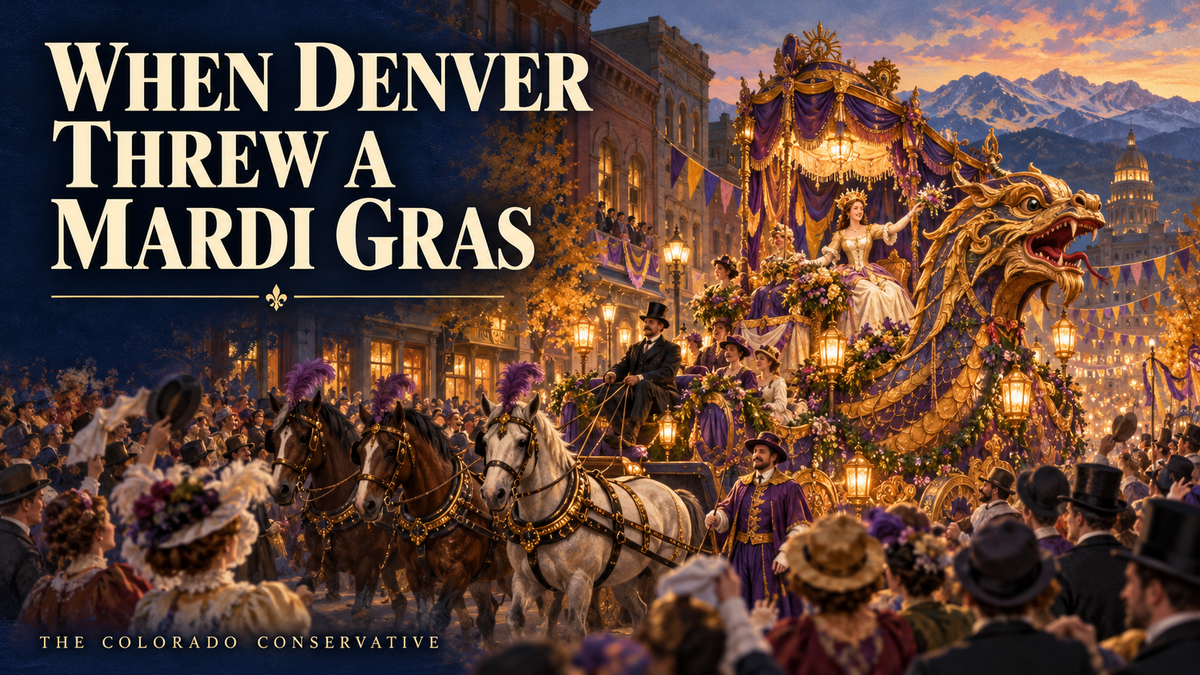
Then, on Wednesday, October 16, the procession reached the streets.
Floats celebrating mining, agriculture, and manufacturing passed through Denver, joined by entries from schoolchildren and civic groups. The grandstand stood at Colfax and Broadway, with the State Capitol overlooking the gathering. [4]
Picture the procession advancing toward it: Colorado's work and wealth turned into moving scenery, each entry taking its place in a pageant that made the street seem like a stage. The organizers' plans had escaped the committee table. Here they came, large enough to pass in front of a grandstand, with another display following behind.
Colorado was introducing itself on wheels. The mountain and plain of the festival's name had become things an audience could watch go by. Across the event's history, mining towns such as Leadville, Cripple Creek, and Victor would contribute alongside agricultural communities including Pueblo, Lamar, La Junta, and Las Animas. [6] Each had something to bring to Denver's party.
The military procession followed the next day. [4] The city had become a place where ordinary routes were given over to extraordinary arrivals, and the show still had another transformation in reserve.
As evening came, more than 3,000 electric globes illuminated 16th Street between Larimer and Broadway. [4]
Picture yourself turning onto that street in 1895. The parade has passed, but the city refuses to close the curtain. Thousands of lights carry your eye along the promenade, drawing the familiar buildings into a glittering stage set. The glow stretches ahead as though somebody has persuaded a constellation to leave the heavens and help Denver entertain its guests.
Denver had dressed for company, and now it had put on its jewelry. The daytime pageant had become an evening enchantment, and the grand finale was still waiting.


Friday brought the sound of competing bands and a different sort of competition among miners demonstrating their drilling skills. [4] Even amidst the finery, Colorado had room to admire the people who knew how to make progress through rock. A day's work could become an attraction when a crowd gathered to appreciate the skill behind it.
Exhibits displayed the state's resources, a free football game offered another diversion, and Ute and Santa Clara participants presented dances, sports, and ceremonies at City Park. Then came the grand allegorical parade and the promised Silver Serpent. [4]
The name had been intriguing enough. The creature was another matter entirely.
Denver's later Civic Center history describes a dragon-like body made of metallic cloth, stretching a block, with hundreds of participants carrying it through the streets, singing and dancing among the crowd. [7]
Imagine watching that long silver form advance. Its body shifts with the people beneath it, the metallic folds catching the light as it moves. There is too much of it to take in at once: a creature whose head belongs to one part of the street while the rest of it is still arriving. Singing and dancing accompany its passage, turning a procession into something that seems to have escaped from a fantastical tale.
Denver had acquired a monster with an appetite for the entire parade route. A splendid monster, admittedly, and one that required hundreds of people to keep its enormous silver body in motion. The city had answered the collapse of its silver fortunes with a creature whose very existence announced that its imagination remained gloriously intact.
The festival's royalty had accessories to match. A queen's tiara preserved in Denver Public Library's collection takes the form of snakes, with green stone eyes and a red tongue. [5] This was a crown that seemed prepared to participate in the spectacle on its own. Understatement had evidently received no invitation.
The scale of the audience matched the ambition. Historical accounts describe attendance above 100,000 in a city whose population was roughly 120,000. [8] The numbers are estimates, and they do not mean everyone occupied the streets at once. Even so, the comparison gives the festival its breathtaking proportions: Denver had attempted a celebration capable of drawing a reported audience approaching the size of the city itself.
Denver had invited company, and company had come in quantities that introduced one final complication. Some visitors stayed longer than planned because the railroads could not keep pace with the demand to carry them away. [3]
A railroad man's idea had produced a party that the railroads could not promptly empty. It is difficult to imagine a more fitting twist in the plot.
The festival returned in later years and added attractions. Rodeo competitions eventually produced a sterling-silver trophy belt decorated with western scenes and a red-eyed bison, because apparently the serpents had not exhausted Denver's interest in dramatic accessories. The early success faded, and a final revival in 1912 could not restore the celebration's former support. [8]


Yet the triumph of October 1895 lay in what Denver had dared to attempt. A recovering city gave itself six weeks to produce a spectacle that would fill its streets with pageantry, illuminate its evenings, and leave a silver monster among its memories. The extraordinary thing is that people made it happen.
They offered their visitors a vision of Colorado larger than its troubles. The skills, industries, and imagination gathered for the festival belonged to a state with a future still to build. For three days, those possibilities had a parade route, a royal court, and thousands of lights.
More than a century later, the invitation still feels tempting. Perhaps Colorado could use a little of that audacity again: an occasion that draws communities together, gives their talents a stage, and sends people home eager to be part of what comes next. A revival can begin with the decision that a place we love deserves something magnificent.
Denver had been in desperate need of a good day. Its people gave it three—and a reason to look forward.
The silver had come from the mountains. The magic had come from the people.
Perhaps it is time to see what those people can conjure again.
Sources and historical notes
1. Historic Denver, The Fall and Rise of the Queen City of the Plains 1893–1904, by Mary Therese Anstey, with contributions by R. Laurie Simmons and Thomas H. Simmons. Economic context and tourism efforts. https://historicdenver.org/wp-content/uploads/sites/7422/2024/07/Fall-and-Rise-of-the-Queen-City-of-the-Plains-1893-1904.pdf
2. Julie Peterson, Becoming Colorado: The Centennial State in 100 Objects, chapter on the Festival of Mountain and Plain rodeo trophy belt; preview identifies Hooper's railroad role and Mardi Gras proposal. https://www.jstor.org/stable/jj.22135984
3. Hannah Parris, Denver Public Library, Festival of Mountain and Plain 1895, August 28, 2017. Planning, committees, name, New Orleans assistance, publicity, crowds, and rail capacity. https://history.denverlibrary.org/news/denver/festival-mountain-and-plain-1895
4. Amy Zimmer, Colorado State Publications Library, Time Machine Tuesday Festival of Mountain and Plain, October 16, 2018. Dates and specific 1895 program details. https://www.coloradovirtuallibrary.org/resource-sharing/state-pubs-blog/time-machine-tuesday-festival-of-mountain-and-plain/
5. Morgan Breitenstein, Denver Public Library, All Hail the Queen of the Slaves of the Silver Serpent, April 27, 2015. Organization and surviving tiara. The story does not assign the tiara or its wearer to a specific festival year. https://history.denverlibrary.org/news/events/all-hail-queen-slaves-silver-serpent
6. BLM cultural-resource history, Land of Contrast A History of Southeast Colorado, chapter 11, hosted by NPS History. Town participation is described across the festival's history, not asserted as an exact list of opening-day 1895 floats. https://npshistory.com/publications/blm/cultresser/co/17/chap11.htm
7. Denver, Civic Center Park Master Plan, 2005, printed pp. 21–22. Description of metallic-cloth serpent and participants; the narrative attributes that description rather than treating it as a independently verified count. https://historicdenver.org/wp-content/uploads/sites/7422/2024/10/CivicCenterPark-MasterPlan-2005.pdf
8. Eric Peterson, Visit Denver, Only in Denver The Rough Riders Trophy Belt, December 18, 2018. Approximate city population, later rodeo belt, and final revival. https://visitdenver.com/blog/post/trophy-belt/
Narrative reflections, fantastical metaphors, and explicitly imagined scenes are literary framing, not eyewitness testimony. The magical atmosphere describes human-made pageantry and does not assert supernatural events. No private dialogue, individual reaction, or interview has been invented. The first festival's dates are October 16–18, 1895; October 22–24 appears in some records as the original planned schedule. Sources differ on the final early-series year, so the story avoids claiming uninterrupted annual festivals through 1902. Later festival attractions are identified as later developments.