
The First Presidential Election
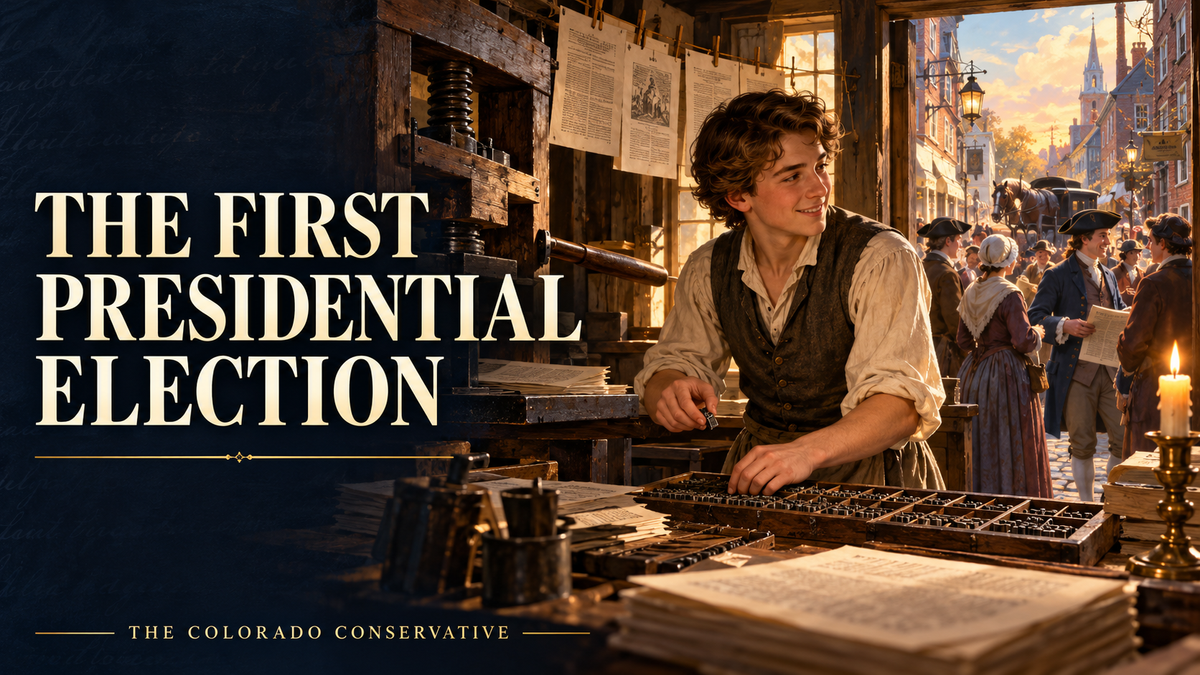
Historical fiction follows a New York printer’s apprentice through the first presidential election and Washington’s inauguration.

From the October 2026 issue of The Colorado Conservative.
Recollections of a printer's apprentice in New York in the years 1788 and 1789
Historical fiction: Thomas Bell and the other private characters, their conversations and personal observations are invented. The public events, election results, and chronology follow the historical sources listed at the end.
When first I set the word President in type, I misplaced a letter.
“Pray put it right,” said Mr. Hale, the printer to whom I was apprenticed. “We have agreed to try a new government. There has been no agreement to let you invent another.”
I corrected the fault and ventured to ask whether a President was something in the nature of a king.
“He is to serve a term of four years,” Mr. Hale replied.
“And afterward?” I asked.
“There must be another election,” said my master.
“Without a death in the family?” I asked.
“Without requiring one,” Mr. Hale assured me. [2]
I laid down my composing-stick. This circumstance deserved both hands free for consideration.
I had been born a subject of His Britannic Majesty. Nobody had consulted me upon the arrangement, though to be just I had then been incapable of answering.
“Suppose he grows fond of the office?” I asked Mr. Hale.
“He must obtain the votes for another term,” my master replied.
“Does His Majesty know of this?” I asked.
“Which Majesty?” said Mr. Hale.
“I should think any of them would find it disturbing,” I told him.

My name is Thomas Bell, and in the autumn of 1788 I was nineteen years of age, serving my apprenticeship in a New York printing-house. Until then, I had supposed that the great affairs of the world were transacted elsewhere, by men quite untroubled by the opinions of apprentices.
Our new arrangement proposed to inquire what a man might do for the country. His master could not answer on his behalf.
This seemed an alarming interruption of a very comfortable method of advancement.
To hear me that winter, one might suppose that no ruler had ever been elected anywhere. Mr. Hale, who had read more than I, put me right, mentioning Poland's elected kings and reminding me that we already chose officers in our own States. [20]
“I wish to give America her due,” I protested.
“She has enough of her own,” said Mr. Hale, “without your taking other people's history.”
I bore this correction with the fortitude usual to apprentices: I said nothing until his back was turned.
The wonder remained: the authority of this new national office was to proceed from the people, and the man chosen to it would owe them service. [21]
The persons for whose use the government existed included farmers, tradesmen and shopkeepers. I knew several such persons. They could be troublesome enough about the price of a printed notice; I began to suspect that governing them might prove a considerable occupation.
Of our preparations to govern ourselves
The shop became a place of almost continual disputation. Gentlemen brought essays concerning the Constitution, and other gentlemen arrived who appeared to have been created for the express purpose of contradicting them.
One customer assured us that the country was saved. Before he left, another proved that it was ruined. Both wanted their notices ready by Thursday.
I listened while setting their arguments in type. Thus, I acquired an education in public affairs at my master's expense, a circumstance of which he had an increasingly exact understanding.
Our independence had been won; the management of it remained troublesome. Under the Articles of Confederation, Congress depended upon the States for money and lacked a general authority to regulate commerce. It could make a request without being certain of an answer. [1]
Mr. Nathaniel Finch, a merchant who had served in the war, explained the difficulty to me. He favoured a government capable of collecting its due and was less hopeful concerning the people who would be asked to pay it.
“Suppose thirteen men agree to dine together,” said Mr. Finch, “and each waits for another to settle the reckoning.”
“Then who pays?” I asked him.
“There,” Mr. Finch replied, “you have found the difficulty.”
Mr. Hale favoured the new Constitution. Mr. Finch examined it as he would a horse offered for sale: he admired its appearance but wished to know whether it had lately thrown anybody.
Their greatest concern was the Presidency. What powers might safely be entrusted to one man? How should he be restrained? And what would become of the office when some less admirable person occupied it?
One gentleman thought Washington's character sufficient security.
“For Washington, perhaps,” Mr. Hale replied. “We cannot order another Washington every four years. Good men are not cast in this shop.”

I had spoiled a line of type that morning and thought it prudent to attend closely to my work.
“Washington does not trouble me,” Mr. Finch said. “The people who expect him to make freedom comfortable trouble me a great deal.”
I thought this a poor compliment to his countrymen. I resolved to find an occasion to improve his opinion of them.
There were men in that shop who had served in the war, and others whose sons had never come home. Their arguments could be foolish; the thing they argued over had cost too much to be treated so.
Occasionally a speaker, growing warm upon liberty, struck his hand upon the counter. Mr. Hale then begged him to spare the wet sheets.
He would defend the people's rights as stoutly as any man. He merely wished them dry before they were handled.
Nor had the world become harmless because we had declared ourselves independent. British troops still occupied western posts within territory recognised as ours. Spain obstructed our use of the Mississippi, and the debts of the war remained to be settled. A new frame of government would inherit the old dangers. [22]
“Will the powers of Europe respect our Constitution?” I asked Mr. Hale.
“I hope so,” my master replied. “But I would not leave the harbour undefended whilst they are reading it.”
I had been thinking chiefly of how we should restrain our own government. It was disquieting to discover that we must also make it capable of protecting us.
Of the election in which we neglected to take part
The manner of choosing the President required some explanation.
Each State's Legislature directed how its electors should be appointed. Some electors were chosen by voters, others by the Legislatures. They would meet in their respective States and each vote for two persons, one at least belonging to another State. The ballots did not separately designate President and Vice President. The person having the greatest number, with the requisite majority, would become President; after that choice, the next highest would become Vice President. [2]
Mr. Hale explained this twice.
“I thought we were choosing a man,” I said.
“We are,” said Mr. Hale.
“Then why does the explanation require so many?” I asked.
Mr. Hale gave me more copy to set, which was his usual remedy when my inquiries became too numerous.
I took comfort in New York's importance. The new federal government was to meet here. Surely our State would have a distinguished part in choosing its first chief magistrate.
We had so distinguished a part that we omitted to perform it.
Our Legislature could not agree upon appointing electors in time. New York consequently cast no electoral votes. North Carolina and Rhode Island took no part because they had not yet ratified the Constitution. Ten States proceeded with the election. [3]
“We are to furnish the government a lodging,” said Mr. Hale, “but have declined to assist in choosing the lodger.”
I could scarcely credit it. After all our arguments about the people's voice, our own Legislature had disputed until the occasion for using it was past.
“We must take better care next time,” I said.
“A sound observation,” Mr. Hale replied. “You may apply it to your spelling immediately.”
My personal share in the election would in any event have been small. I was but nineteen. Our State's constitution confined the suffrage to men of full age, with qualifications concerning property, rent and taxation, and certain exceptions. My mother had no vote here. [4]
This was difficult to reconcile with the authority she exercised over my opinions at home.
When I explained the electoral arrangements over supper, she listened with a patience I had not expected to survive the account.
“And whom would you choose?” my mother asked.
“General Washington,” I told her.
“Then you might have told me so before explaining the entire Constitution,” my mother replied. “The broth is cold.”
Some women qualified to vote across the water in New Jersey, under that State's constitution. The rules differed, and many people were excluded. [5] My mother did not mistake her lack of a ballot for a want of judgment.
“If they should require an opinion,” my mother said, “they know where to find me.”
There was a graver contradiction in our professions of liberty. Slavery remained lawful in New York. Men spoke of the rights of mankind in streets where other men and women were held as property. [6]
The grand words we printed did not put that injustice right. They made it harder to excuse.
I was coming to perceive how much depended upon whom we admitted under the name of the people.
Of the gentleman who had already gone home once
Whatever doubts surrounded the Constitution, Washington's name commonly enjoyed a better reception.
I heard men agree upon him who would have quarrelled over the proper disposition of a candlestick. One distrusted the new government's powers but hoped they might safely be lodged in the General's hands. Another thought his acceptance would reconcile doubtful neighbours to the undertaking.
Mr. Hale put me in mind of what Washington had done after the war. In December 1783, he resigned his military commission to Congress and returned to private life. Having commanded the army, he surrendered the authority entrusted to him. [7]
“He went home,” said Mr. Hale.
“Yes, sir,” I answered.
“Without being driven there,” my master added.
I considered this. Some gentlemen could not surrender their turn at our counter without a speech upon the injustice of it. Washington had surrendered command of an army.
A man who had already demonstrated that he could leave an office seemed a promising person to invite into another.
He remained at Mount Vernon while the preparations went forward. I knew little then of his private inclinations. In later years, reading of his reluctance to leave retirement, I understood better the burden we were asking him to accept. [8]
We proposed to summon him from his own affairs, give him charge of ours, and then complain whenever he conducted them differently from our several opinions.
It was perhaps fortunate that the official notice did not state the matter quite so plainly.
“What if we choose badly?” I asked Mr. Hale.
“Then we shall have cause to choose better,” my master replied.
“And must the people attend to all this?” I asked.
“Did you suppose self-government was a contrivance for sparing them the trouble?” Mr. Hale replied.
I had entertained some hope of it.


Of choosing a President and waiting for Congress to arrive
Electors were selected during December 1788 and January 1789. On the fourth of February they cast their ballots, and their certified returns were sent to the seat of government for the count. [9]
The intelligence reached us by degrees. A traveller brought one account, a letter another. A customer might assure us of a report on the authority of a gentleman who had heard it from a gentleman who was acquainted with a third.
By the third gentleman, Mr. Hale generally returned to his press.
We expected Washington to prevail. But a town's confident expectation was not an official count, and Congress was appointed to assemble on the fourth of March.
The fourth of March arrived punctually. Congress was less successful.
Bad roads and severe weather delayed the members. Neither House could at first make a quorum. The Representatives obtained theirs on the first of April, and the Senate on the sixth. [10]
I had feared that a government might be too powerful. I had not considered that we should first have to persuade enough of it to arrive.
Meanwhile, notices required printing, the fire wanted tending, and our customers continued to find things for us to do. Liberty had made a beginning without diminishing the number of errands assigned to apprentices.
On the sixth of April the returns were at last counted.
Sixty-nine electors had voted. Everyone had named George Washington. Mr. John Adams received thirty-four votes and became Vice President. Other names included Mr. Jay, Mr. Rutledge and Mr. Hancock. [11]
Each elector had two choices. Adams's thirty-four votes came from men who had also named Washington; the two gentlemen had not been opposing candidates for the Presidency.
“Every elector?” I asked Mr. Hale.
“Everyone who voted,” my master replied.
Mr. Hale insisted that I distinguish agreement among the electors who voted from the opinions of every American.
No pedigree was required beneath the totals. I found this an agreeable saving of type.
Of receiving our chosen magistrate
Congress dispatched Charles Thomson to Mount Vernon with the official notice. Washington received it on the fourteenth of April, departed on the sixteenth, and reached New York on the twenty-third. [12]
While he travelled, the town assumed the manner of a household expecting a guest of great consequence. Persons lately doubtful whether anything could be accomplished now knew precisely how everybody else ought to accomplish it.
At the wharf I found a forest of hats above a shifting confusion of shoulders. The air smelt of tar and river water. Men who ordinarily passed one another without a nod were asking questions as freely as old acquaintances; nobody would confess to knowing less than his neighbour.

Music came from the vessels upon the water. Then a cannon spoke, and for an instant every conversation near me was broken off. Smoke spread above the shipping; before it had thinned, another report rolled across the harbour. Flags stirred over the boats accompanying the General's barge. [13]
I obtained a place from which I could see almost everything except Washington.
A gentleman's shoulder supplied the deficiency. I raised myself upon my toes; he raised himself upon his. Our views remained equal, though mine had cost me more effort.
At length the crowd shifted. Through a narrow opening I saw the barge, its red drapery bright against the water, the oars rising and dipping in a steady measure. The rowers' white smocks and black caps made them appear wonderfully agreed upon what they were doing. [13]
Behind me, three gentlemen were attempting to agree upon where to stand. The contrast was instructive.
For months I had set Washington's name in type. Now the man himself was coming ashore, and the town called out to him as though every inhabitant had privately arranged the visit.
I shouted with the rest. If the President was to serve the people, it seemed proper to give him some notion of their number.
As the vessel drew in, men took off their hats and lifted them again, unable to settle upon a sufficient gesture. A fellow beside me shouted until he coughed, recovered himself, and resumed his contribution. I found that I was grinning at strangers, who grinned back without requiring an introduction.
When the General passed from my sight, I remained where I was, listening to the cheering travel along the waterfront. The name I had handled as little pieces of metal had become a man with an immense expectation waiting for him on shore.
The thirtieth of April 1789
On the morning appointed for the inauguration, my mother inspected my hands.
“Wash them again, Thomas,” my mother said.
“Do you suppose the General will inspect them?” I asked.
“No,” my mother replied. “I have spared him the trouble.”
I obeyed. There appeared to be no constitutional restraint upon this branch of the household.
Mr. Hale gave me leave to attend. He intended to go himself, so that we were happily agreed upon an afternoon's business which required neither of us to remain at work. We went together.
At Wall and Broad Streets, the crowd thickened until our progress ceased to be a matter of choice. A step opened before me; I took it, and somebody took the space I had left. Coats brushed my face. The brim of a hat threatened my eye. Above us, faces leaned forward from the windows, enjoying a prospect which I considered a considerable advantage.
The old City Hall had been remodelled under Pierre L'Enfant's direction for the federal government. I could see its balcony beyond the lifted heads; there the oath would be administered in public. [14]

“A fine demonstration of the people's sovereignty,” I said to Mr. Hale. “I cannot move either arm.”
“Then mind your pockets,” my master replied. “Liberty has not abolished thieves.” A woman nearby lifted her child. Behind us, a gentleman called repeatedly for the company to move to the left. Since nobody had room to oblige him, he supplied his advice more loudly, as if the difficulty lay in our hearing. Somewhere farther off a voice called that the General had arrived. Heads turned before anybody near me could see him. The news moved through the crowd in little bursts, followed by efforts to stand taller. Then there was a movement upon the balcony, and Washington came into view. The brown of his American-made suit seemed quiet above all our restless colours. [15] I had seen his likeness often enough, yet the sight of him startled me. I found myself attending to small things: the turn of his head, the pause before he took his place, the space the other gentlemen allowed him. Below, hats rose and sank as people struggled to look between them. Mr. Hale touched my sleeve and pointed. For once, he had no correction to offer. A Bible was held before Washington, and Mr. Livingston, Chancellor of New York, administered the oath. [16] Around me, voices fell away unevenly. A man still speaking was hushed by two persons at once; the child beside us stopped waving. I could not hear every word. Having read the prescribed form, I could follow its meaning: Washington was binding himself to preserve, protect and defend the Constitution of the United States. I had spent the morning being told to wash my hands. Here was the foremost man in the country, and before he could begin his employment, he too had a requirement to satisfy. When the oath was finished, the cheering broke upon us so suddenly that I felt it before I thought to join it. Hats swept upward. My neighbour's elbow struck my ribs, and I forgave him without consideration. Bells began to ring above the noise. [18]
I had intended to observe the ceremony with exactness. Instead, I discovered myself shouting at a volume which would have earned me immediate dismissal from my mother's table. The woman beside me was laughing and weeping together; her child waved both hands, evidently satisfied with the choice.
Washington bowed to the people. [18] For a moment I could see him clearly between two raised hats. Then the hats came together, and he was gone from my view. I went on cheering into the back of a gentleman's coat.
Several heads away I caught sight of Mr. Finch, his hat raised as high as anybody's. I was pleased to find that his affection for the country had survived his opinion of it.
Washington withdrew to address Congress. Afterward, I read his speech. Its anxiety surprised me after so much rejoicing: he warned against sectional prejudices and the animosities of party and spoke of liberty itself as depending upon the experiment entrusted to the American people. His appeal for God's blessing was accompanied by a grave account of our own responsibility. [17]
I had supposed we were putting the whole burden upon him. It appeared that he intended to leave a considerable part with us.
There followed a service at St. Paul's. By evening, fireworks and illuminations had given the town another occasion to crowd its streets. [18] Light shone from the windows against the dark fronts of houses. A burst overhead brought faces into view, mouths open and eyes turned upward; then the darkness took them back.
The smell of spent powder lingered as we made our way home. Snatches of conversation followed us past doorways. I had never heard so many people sound pleased with belonging to the same country.
At home, my mother asked for an account. I described the balcony, the suit, Mr. Livingston and the crowd.
“And the President has taken his oath?” my mother asked.
“He has,” I told her.
“Then let him attend to it,” my mother said. “You may attend to the supper.”
Our respective duties were thus made perfectly clear.
Of the people and their President
The following morning, the shop resumed its accustomed work. A customer wanted his order earlier than promised. Mr. Finch returned for his notice and wished it altered after it had been set. Self-government had not improved either gentleman's manners.
I gave Mr. Finch an account of the inauguration, with particular attention to the temper of the crowd.
“I was there,” the merchant said. “I lost a button. The crowd's affection was considerable.”
“Then you must allow that the people mean to make a success of it,” I replied.
“They mean to be happy,” Mr. Finch said. “This republic will not last. In time they will tire of the trouble of keeping it.”
“The people who fought for their independence?” I asked him.
“The very same,” Mr. Finch replied. “A man may risk his life to be free and afterwards resent the time it takes to remain so. Let somebody promise to relieve him of his cares, and he will grant powers he would once have taken up arms to resist.”
“I think you judge our countrymen too meanly,” I said. “They did not bury their neighbours merely to become subjects again.”
“Nor did I bury my brother for that purpose,” the merchant answered. “But they will not call it ‘becoming subjects.’ They will call it a necessary power, granted for their own ease and protection. They will still have their shops and their suppers. The public business will be somebody else's concern, until they discover how much of their own business has become the public's.”
“Or perhaps our generation will remember, and the forgetting will be left to our children,” Mr. Finch added. “They may inherit liberty without knowing its price and hear of the war only over supper. Never having lived as subjects, they may think a ruler’s promises worth more than their own independence.”
I looked to Mr. Hale. I expected the answer he generally kept ready for a gentleman who carried an argument too far. My master squared the papers before him, taking a care over their edges which I found wholly unnecessary.
“With time, we shall see,” Mr. Hale said.
This shocked me more than Mr. Finch's prophecy.
“You cannot agree with him, sir?” I asked my master.
“I agree that we may lose what we have won,” Mr. Hale replied. “The nation is young, and its safety is no settled thing. We may weaken it by our quarrels or give a favourite more authority than the laws allow because we like what he promises to do with it. Men who died for our independence cannot return to correct our folly.”
“Then we must prove Mr. Finch mistaken,” I said.
“By your conduct, I hope,” my master replied. “You will not preserve a republic by being offended on its behalf.”
I found this a disagreeable distinction. I had been doing very well at being offended.
“Must we examine every promise?” I asked Mr. Hale.
“You are particular enough over a pair of shoes,” my master replied.
“A bad shoe pinches immediately,” I said.
“A bad measure may wait until you have grown fond of its author,” Mr. Hale answered.
Mr. Finch paid for his notice and departed. He wished us a good morning with sufficient sincerity to make it impossible to dismiss him as a man who desired the failure he predicted.
I still believed him wrong. Yet I could no longer suppose that the noise below the balcony had answered him. I wanted our countrymen to answer him by the use they made of their freedom.
I looked down at my ink-stained hands. Our little shop could print the laws, the promises and the accounts of public conduct. It could also print flattering falsehoods and teach our neighbours to applaud them. We should have our share in what followed.
Mr. Hale picked up his composing-stick. I returned to mine. On the next sheet, I found a word I had set incorrectly and put it right before the press could multiply it.
For my own part, I could not believe that our countrymen would ever give away a freedom so dearly purchased merely to be spared its trouble. Mr. Finch might know the world better than I; he could not persuade me that it contained so little courage.
And if some should forget, others would remember. There would be men and women who saw the folly, spoke against it, and stood firm for the liberties their neighbours were being persuaded to surrender. They would question the promises, demand an account, and refuse to be quiet merely because quiet was more comfortable.
Somewhere there would be another printing-house, and somebody with the spirit to put the warning into type. I hoped he would spell it correctly. I meant to be of his company.
Yet, despite Mr. Finch’s warning, I took this small comfort: we had chosen a President, not acquired a master. Sources and historical notes
Research checked October 12 2026.
1. National Archives, Articles of Confederation, and The Constitution How Did It Happen. Background on the Confederation government's dependence on state funding and its lack of authority to regulate commerce. https://www.archives.gov/milestone-documents/articles-of-confederation https://www.archives.gov/founding-docs/constitution/how-did-it-happen 2. National Archives, The Constitution of the United States A Transcription, original Article II Section 1, and George Washington's Mount Vernon, An Imperfect Election. State legislatures determined the manner of appointing electors, and selection methods varied. Electors each voted for two persons, at least one from outside their state. Votes were not separately designated for president and vice president. The Constitution also provided contingent procedures for ties or the absence of a presidential majority. https://www.archives.gov/founding-docs/constitution-transcript https://www.mountvernon.org/george-washington/the-first-president/election/imperfect-election 3. National Archives, The First Presidential Inauguration, January 15 2025. Only ten states cast electoral ballots. New York failed to appoint electors; North Carolina and Rhode Island had not ratified the Constitution. The article does not treat their absence as a rejection of Washington by their residents. https://prologue.blogs.archives.gov/2025/01/15/the-first-presidential-inauguration/4. Yale Law School Avalon Project, The Constitution of New York April 20 1777, particularly sections VII and X. These provisions describe the state franchise, including sex, age, residence, property and tax qualifications and exceptions. Thomas Bell and his mother's circumstances are fictional. There was no presidential popular vote in New York in this election. https://avalon.law.yale.edu/18th_century/ny01.asp 5. Library of Congress, New Jersey Women Gain then Lose the Vote. New Jersey's constitution allowed some women meeting its qualifications to vote. The story does not assert that all women were eligible or that Thomas's mother had such rights in New York. https://www.loc.gov/exhibitions/women-fight-for-the-vote/about-this-exhibition/seneca-falls-and-building-a-movement-1776-1890/early-feminist-inspirations/new-jersey-women-gain-then-lose-the-vote/6. National Park Service, Schuyler Estate. Documents slavery in New York during the founding era and the state's later gradual emancipation laws. https://www.nps.gov/places/schuyler-estate.htm 7. George Washington's Mount Vernon, Resignation of Military Commission. Washington resigned his commission to Congress at Annapolis on December 23 1783. The dialogue about that decision is invented. https://www.mountvernon.org/library/digitalhistory/digital-encyclopedia/article/resignation-of-military-commission 8. George Washington's Mount Vernon, Answers the Call. Washington's reluctance to leave retirement is documented in his correspondence. The narrator explains that he learned about these private concerns later. https://www.mountvernon.org/george-washington/the-first-president/election/unretirement 9. George Washington's Mount Vernon, Presidential Election of 1789. Electors were selected between December 15 1788 and January 10 1789, and cast ballots on February 4. The story's shop and its receipt of news are fictional. https://www.mountvernon.org/library/digitalhistory/digital-encyclopedia/article/presidential-election-of-1789 10. National Archives, First Journal of the Senate, April 6 1789. The new Congress's intended opening date was March 4. The House achieved a quorum on April 1 and the Senate on April 6, when the electoral count took place. https://www.archives.gov/exhibits/treasures_of_congress/Images/page_2/10b.html
11. National Archives, 1789 Electoral College Results. All 69 electors who voted named Washington; 34 named Adams. These were electoral ballots under the original two-choice system, not the results of a modern national popular vote or a Washington versus Adams presidential contest. https://www.archives.gov/electoral-college/1789 12. National Archives, The First Presidential Inauguration. Charles Thomson delivered official notice on April 14. Washington departed Mount Vernon on April 16 and arrived in New York on April 23. https://prologue.blogs.archives.gov/2025/01/15/the-first-presidential-inauguration/13. George Washington's Mount Vernon, Inauguration in New York City. Documents the barge, accompanying vessels, music, cannon salutes and crowds at Washington's arrival on April 23. Thomas's position, observations and reactions are invented. https://www.mountvernon.org/george-washington/the-first-president/inauguration/new-york 14. National Park Service, The Congress at Federal Hall. Pierre L'Enfant remodeled the former city hall for the new federal government.
https://home.nps.gov/feha/learn/historyculture/the-congress-at-federal-hall.htm 15. National Park Service, Inaugural Balcony. Washington wore an American-made dark brown suit at the April 30 inauguration. The narrator's interpretation of the clothing is literary commentary. https://home.nps.gov/feha/learn/historyculture/inaugural-balcony.htm 16. National Archives, George Washington's First Inaugural Address April 30 1789, and National Park Service, The George Washington Inaugural Bible. Robert Livingston administered the oath at Federal Hall. The narrator's inability to hear every word is fictional. https://www.archives.gov/legislative/features/gw-inauguration https://www.nps.gov/feha/learn/historyculture/george-washington-inaugural-bible.htm 17. National Archives, President George Washington's First Inaugural Speech, including the transcript. Washington delivered the address inside the Senate Chamber after taking the oath. His anxiety, reluctance and appeal for divine assistance appear in the speech. Thomas reads it afterward rather than claiming to hear it from the street. https://www.archives.gov/milestone-documents/president-george-washingtons-first-inaugural-speech 18. National Archives, George Washington's First Inaugural Address April 30 1789, and George Washington's Mount Vernon, Inauguration in New York City. Documents the service at St. Paul's and the evening celebrations. https://www.archives.gov/legislative/features/gw-inauguration https://www.mountvernon.org/george-washington/the-first-president/inauguration/new-york 19. Language references consulted October 15 2026: Benjamin Franklin, Autobiography, and William Maclay, Journal, April 1789, in public-domain transcriptions. Their vocabulary and sentence patterns informed the fictional narrative and dialogue. https://www.gutenberg.org/files/20203/20203-h/20203-h.htm https://en.wikisource.org/wiki/Journal_of_William_Maclay/First_Session_of_the_First_Congress/On_Titles_and_Ceremonies 20. Polish Ministry of Education platform, Foundations of the Commonwealth, and New York Constitution of 1777. Elections for rulers predate 1789: Polish nobles elected kings, and Americans already elected state officers. The narrator expresses wonder at the new American national presidency, rather than claiming that America invented voting for rulers. https://zpe.gov.pl/a/foundations-of-the-commonwealth/D16UhfQMA https://avalon.law.yale.edu/18th_century/ny01.asp 21. Library of Congress, Consent of the Governed, and National Archives, Declaration of Independence transcript. Sources for the principle that legitimate governmental authority derives from the people. The story distinguishes that principle from the restricted franchise and slavery of the founding era. https://www.loc.gov/exhibitions/declarations-promise/about-this-exhibition/consent-of-the-governed/https://www.archives.gov/founding-docs/declaration-transcript 22. U.S. Department of State Office of the Historian, Constitutional Convention and Ratification 1787 to 1789. Background on British retention of military posts, Spanish restrictions on American navigation of the Mississippi, and Revolutionary War debt. These unresolved problems give historical context to the fictional discussion of national security. Mr. Finch and his wartime history are invented, as is the dialogue about citizens endangering their own republic; Washington's actual inaugural concern for the survival of liberty and republican government appears in source 17. https://history.state.gov/milestones/1784-1800/convention-and-ratification
Linked references from the print edition
- www.archives.gov/milestone-documents/articles-of-confederation
- www.archives.gov/founding-docs/constitution/how-did-it-happen
- www.archives.gov/founding-docs/constitution-transcript
- www.mountvernon.org/george-washington/the-first-president/election/imperfect-election
- prologue.blogs.archives.gov/2025/01/15/the-first-presidential-inauguration/
- avalon.law.yale.edu/18th_century/ny01.asp
- www.loc.gov/exhibitions/women-fight-for-the-vote/about-this-exhibition/seneca-falls-and-building-a-movement-1776-1890/early-feminist-inspirations/new-jersey-women-gain-then-lose-the-vote/
- www.nps.gov/places/schuyler-estate.htm
- www.mountvernon.org/library/digitalhistory/digital-encyclopedia/article/resignation-of-military-commission
- www.mountvernon.org/george-washington/the-first-president/election/unretirement
- www.mountvernon.org/library/digitalhistory/digital-encyclopedia/article/presidential-election-of-1789
- www.archives.gov/exhibits/treasures_of_congress/Images/page_2/10b.html
- www.archives.gov/electoral-college/1789
- www.mountvernon.org/george-washington/the-first-president/inauguration/new-york
- home.nps.gov/feha/learn/historyculture/the-congress-at-federal-hall.htm
- home.nps.gov/feha/learn/historyculture/inaugural-balcony.htm
- www.archives.gov/legislative/features/gw-inauguration
- www.nps.gov/feha/learn/historyculture/george-washington-inaugural-bible.htm
- www.archives.gov/milestone-documents/president-george-washingtons-first-inaugural-speech
- www.gutenberg.org/files/20203/20203-h/20203-h.htm
- en.wikisource.org/wiki/Journal_of_William_Maclay/First_Session_of_the_First_Congress/On_Titles_and_Ceremonies
- zpe.gov.pl/a/foundations-of-the-commonwealth/D16UhfQMA
- www.loc.gov/exhibitions/declarations-promise/about-this-exhibition/consent-of-the-governed/
- www.archives.gov/founding-docs/declaration-transcript
- history.state.gov/milestones/1784-1800/convention-and-ratification


