
How America Learned to Haunt the Neighborhood
How old traditions, neighborhood celebrations, mischief, and candy helped shape the American Halloween.

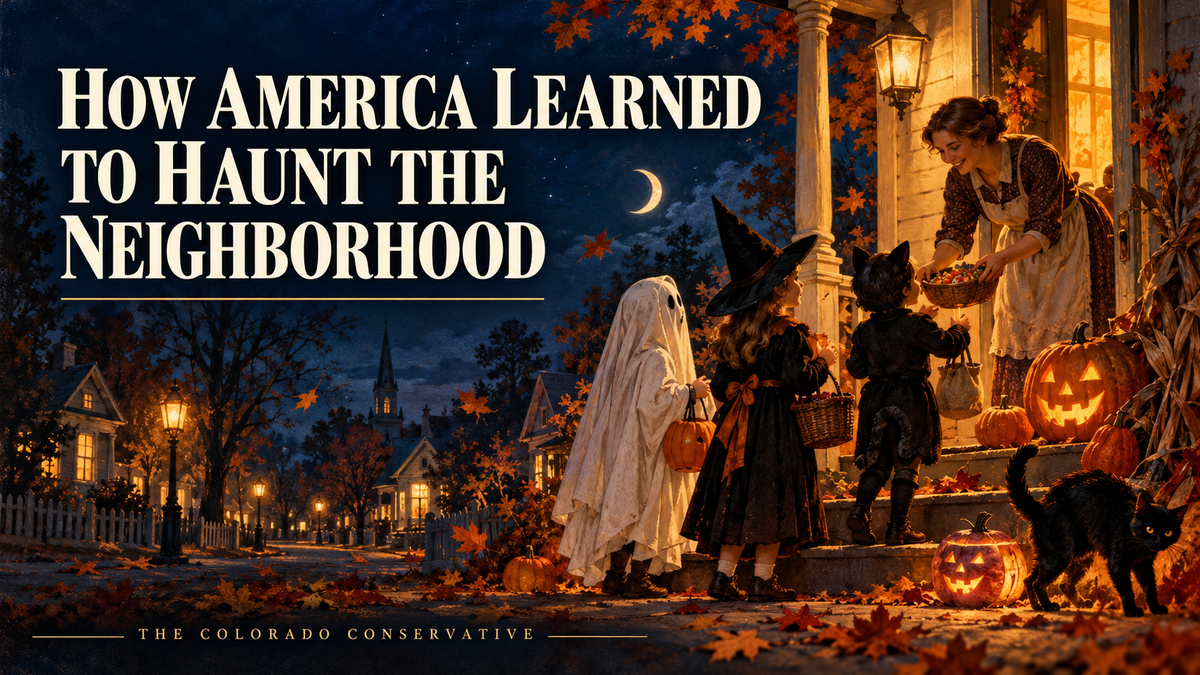
From the October 2026 issue of The Colorado Conservative.
The wonderfully peculiar history of Halloween in America
Every October, Americans perform a remarkable act of confidence: we fill our yards with evidence of a supernatural catastrophe and then invite the neighbors over.
Skeletons climb the gutters. A witch has collided with a tree. Something enormous and inflatable is breathing beside the hydrangeas. The homeowner, who spent the rest of the year trying to improve the property's curb appeal, has apparently decided that what the place really needed was a shallow grave.
Meanwhile, children are being prepared for an evening of highly organized candy acquisition.
For eleven months and thirty days, we teach them to avoid strangers, eat sensibly, and wear clothes appropriate to the weather. On October 31, we send them to unfamiliar doorsteps dressed as escaped laboratory experiments, carrying containers large enough to suggest a purchasing agreement.
It is a wonderful holiday.
It also took centuries of borrowing, improvisation, courtship, mischief, and commercial enthusiasm to become the evening we recognize today. Halloween has had a surprisingly eventful career for something that now spends so much of its time in the seasonal aisle.
Its older roots reach across the Atlantic. In the traditional Irish calendar, Samhain marked the beginning of winter on November 1, with festivities on the preceding evening. Customs associated with the occasion included feasting, games, disguises, predictions about marriage, and beliefs that the dead might return to their former homes. Christianity contributed the name: Halloween is a shortened form of All Hallows' Eve, the evening before All Saints' Day. Today's holiday carries several strands of that long history. [1]
Imagine facing the approach of winter in a countryside without electric lights, with the additional possibility that deceased relatives might be dropping by.
Winter was already a substantial undertaking. Now someone had to worry about entertaining Uncle Seamus.
The old customs offered food, company, and ways to make an unsettling night manageable. That combination would travel well.
Irish and Scottish immigrants brought Halloween traditions to America, including a taste for seasonal mischief. The nineteenth century brought large waves of Irish immigration, especially following the famine that began in the 1840s. Families carried their celebrations with them, and Halloween gained popularity in American life during the late 1800s. [2]


America, as it turned out, had both an appetite for a party and an excellent vegetable for the occasion.
Before the grinning pumpkin became the holiday's unofficial ambassador, Irish Halloween lanterns could be made from carved turnips. The National Museum of Ireland preserves a painted plaster cast based on a turnip lantern collected in 1943, of a type its donor said had been made locally around 1900. Candles inside the carved faces helped frighten people on Halloween night. [3]
A pumpkin can look cheerful, startled, or vaguely disappointed in your carving ability. A turnip lantern looks as though it has spent forty years keeping a terrible secret.
It is also a formidable assignment for the person doing the carving. Imagine announcing a pleasant family craft evening and handing everyone a dense root vegetable.
The name jack-o'-lantern is associated with the folktale of Jack, a man welcome in neither Heaven nor Hell, condemned to wander with, you guessed it... a lantern. The familiar pumpkin version developed in America from the Irish lantern tradition. [3]
Jack's eternal predicament eventually produced a porch decoration. That is quite a legacy for a man whose afterlife arrangements had gone so badly.
But Halloween's American social life was about to become stranger still.
For many young adults in the Victorian era and early twentieth century, the holiday offered an
opportunity to investigate the most frightening question of all: whom they might marry.
A Philadelphia newspaper in 1914 described romantic fortune-telling games. In one, a person plucked a strand of hair and released it outdoors; the direction it blew supposedly indicated where a future spouse lived. Another involved walking backward in the moonlight while looking into a mirror and reciting a verse to reveal the future beloved. [4]
The wind was doing the work of a dating service, with considerably fewer personal details.
Walking backward while watching a mirror seems more likely to introduce you to a shrub than a spouse. Still, a holiday that provided an excuse to gather eligible young people in a room had certain practical advantages. Fate might need help. Fortunately, there were refreshments.
Ruth Edna Kelley's The Book of Hallowe'en, published in 1919, offers a glimpse of American celebrations a century ago. Her descriptions include masked guests, pumpkin lanterns, cornstalk decorations, and tables supplied with doughnuts, gingerbread, cider, apples, nuts, and popcorn. She also recorded fortune-telling cakes containing objects such as a ring, a key, or a coin, each promising a different future and, in this humble writer’s opinion, an open invitation for a lawsuit related to peculiar choking hazards. [5]
Imagine being served dessert with the possibility of matrimony, travel, or a small piece of hardware lodged in your throat, but I digress.


Outside the parlor, other celebrants were pursuing a less romantic program. Kelley described Halloween mischief involving missing gates, stolen doorknobs, flour tossed at passersby, and mysterious knocking. [5]
The distinction between an amusing prank and an exhausting morning was often determined by whose gate had disappeared.
As Halloween expanded, communities had to contend with the damage that could accompany the revelry. The challenge was to give young people something enjoyable to do while preserving a reasonable number of doors, windows, and municipal fixtures.
Anoka, Minnesota, supplied one memorable answer.
In 1920, local businessman, George Green, and other residents organized a Halloween celebration intended to redirect youthful mischief into festivities. The Anoka County Historical Society notes that local tradition and newspaper accounts connect the project to the town's recurring Halloween trouble. [6]
The festival's organizers tell of cows roaming Main Street, soaped windows, and overturned outhouses... yuck. Whatever one's affection for high spirits, discovering that the facilities had been repositioned must have tested it and definitely would have stunk. [7]
Anoka responded with a costume parade, treats for the children who marched, and a large bonfire at Bridge Square. Businesspeople, teachers, parents, students, bands, and civic organizations helped make the evening happen. [7]
It was an inspired piece of adult reasoning: the children clearly intended to organize something. Perhaps the town should get involved before livestock became part of the program.
Anoka's celebration became an enduring tradition. Its story captures a wider change in American Halloween: communities increasingly sought to turn a troublesome night into a shared occasion.


Door-to-door treats had older European relatives, too. In the tradition of guising, disguised visitors entertained households in exchange for something to eat. America's modern trick-or-treating developed gradually during the early twentieth century; one explanation for its spread is that organized festivities helped communities discourage destructive pranks. [8]
A little performance, a little suspense, a little food: the essential ingredients were gathering.
Then World War II complicated the sweet part of the arrangement.
The United States introduced sugar rationing in 1942, and household sugar remained rationed until June 1947. War disrupted supplies and forced families to budget an ingredient that had previously been far easier to obtain. Halloween treats competed with the needs of the everyday kitchen. [9]
Under those circumstances, a parent could be forgiven for looking at a proposed batch of Halloween sweets and wondering whether the ghosts might accept something less demanding.
The postwar years gave trick-or-treating new momentum. Growing families and expanding suburbs helped it become a familiar American childhood ritual. [10]
Popular culture joined in. Disney released the Donald Duck cartoon Trick or Treat in October 1952. Donald's nephews arrive in costume, Donald plays tricks on them, and Witch Hazel intervenes to help the children get their candy. [11]
The doorbell now had the support of a witch and an animation studio. Resistance was becoming impractical.
The treats themselves were changing. Early trick-or-treaters might receive homemade cookies, cake, popcorn balls, apples, coins, or small trinkets. During the 1950s, candy companies increasingly promoted packaged sweets for Halloween. Individually wrapped candy offered households convenience, and it became an economical way to serve growing numbers of visitors. [12]
For the person answering the door, a bag of ready-made candy solved several problems at once. There was no baking, no washing up, and substantially less opportunity for a miniature pirate to assess the quality of your gingerbread.
The seasonal candy display was finding its purpose.
Candy corn deserves a moment here, because it has somehow survived generations of Americans passionately disagreeing about it. In its early commercial history, Goelitz sold it as “Chicken Feed.” The little kernels appealed to the agricultural imagery of the period. [13]
That is a bold name for a product intended for human enjoyment.
Today, one person regards candy corn as an essential autumn pleasure. Another regards it as a decorative material that has wandered into the food supply. Both will explain their position at length if allowed.

Costumes were becoming a business, too. Founded in Brooklyn in 1937, Ben Cooper, Inc. became a major manufacturer of Halloween costumes, selling through retailers such as Woolworth's. Dressing up could increasingly begin with a shopping trip. [14]
The old impulse to become someone—or something— else found an expanding range of possibilities. A child could arrive at the door as a monster, a hero, or a character the adult holding the candy had absolutely no chance of identifying.
This last tradition remains remarkably vigorous.
Ask a child who they are supposed to be, and you may receive a detailed explanation involving three imaginary universes and a transformation sequence. The safest response is admiration followed by chocolate.
By then, the pieces of modern American Halloween were in place: the porch lantern, the costume, the neighborhood route, the treats, the party, and the pleasant understanding that almost everyone was pretending.
We have kept adding to the spectacle. Some front yards now contain skeletons tall enough to supervise roof repairs. Dogs participate under varying degrees of protest. Adults pay to walk through buildings where other adults are employed to startle them.
Somewhere along the way, fear acquired a customer service department.
Yet the pleasure at the center of the holiday remains wonderfully simple.
For an evening, the neighborhood becomes a place to explore. A familiar sidewalk leads past glowing faces and improbable creatures. Adults who ordinarily exchange a quick wave stop to admire a costume. A shy child rehearses three words, rings a bell, and discovers that someone was waiting with a bowl.
The holiday has gathered ghosts, saints, immigrant customs, romance, practical jokes, civic celebrations, cartoons, and a great deal of confectionery into one peculiar American evening. Each generation has found something to add.
Now it is our turn to light the porch.
The witch can stay in the tree. The skeleton can keep climbing the gutter. A small astronaut is coming up the walk, accompanied by a dinosaur who has lost a shoe, and both have urgent business.
After centuries of effort, America has made an old night of mystery into a pretty good excuse to meet the neighbors.
Just save a few pieces of candy for the people doing all the work.
History has been hard enough on them. They used to have to carve the turnips.
Sources and historical notes
1. National Museum of Ireland, “Traditions and customs of Halloween / Samhain.” https://source.museum.ie/en-IE/Collections-Research/Folklife-Collections/Folklife-Collections-List-(1)/Religion-and-Calendar-Customs/Hallowe-en-Samhain
Costumes from the magazine


2. Library of Congress, “The Origins of Halloween Traditions”; “Irish-Catholic Immigration to America”; National Museum of American History, “From homemade Halloween treats to colorfully packaged candies.” https://blogs.loc.gov/headlinesandheroes/2021/10/the-origins-of-halloween-traditions/https://www.loc.gov/classroom-materials/immigration/irish/irish-catholic-immigration-to-america/https://americanhistory.si.edu/explore/stories/homemade-halloween-treats-colorfully-packaged-candies
3. National Museum of Ireland, “Ghost turnip,” collection F1943.350. https://source.museum.ie/en-IE/Collections-Research/Collection/Top-things-to-see-in-the-Irish-Folklife-Collection/Artefact/Ghost-turnip/b202e8ea-0728-4b3d-b0f1-82660fe45ce9
4. Library of Congress, “Century-old Tricks for Finding Your True Love on Halloween,” discussing an October 31, 1914 Philadelphia Evening Public Ledger article. https://blogs.loc.gov/catbird/2015/10/century-old-tricks-for-finding-your-true-love-on-halloween/
5. Ruth Edna Kelley, The Book of Hallowe'en (1919), chapter XV, “Hallowe'en in America.” Used as evidence of celebrations described in her era. https://dev.gutenberg.org/cache/epub/20644/pg20644-images.html
6. Anoka County Historical Society, “Anoka Halloween: The Centennial.” https://anokacountyhistory.org/anoka-halloween-the-centennial
7. Anoka Halloween, Inc., “The History of Anoka Halloween.” The descriptions of cows, windows, and outhouses are attributed to the organizers' historical account. https://anokahalloween.com/history/
8. National Museum of Ireland, “Ghost turnips, the púca, fortune-telling and evil abductions...how our ancestors inspire our Halloween celebrations today”; HISTORY, “How Trick-or-Treating Became a Halloween Tradition.” https://source.museum.ie/en-IE/News/2023/Ghost-turnips%2C-pucas%2C-fortune-telling-and-evil-abd https://www.history.com/articles/halloween-trick-or-treating-origins
9. Megan E. Springate, National Park Service, “Sugar: The First and Last Food Rationed on the World War II Home Front.” https://www.nps.gov/articles/000/sugar-the-first-and-last-food-rationed-on-the-world-war-ii-home-front.htm
10. HISTORY, “How Trick-or-Treating Became a Halloween Tradition.” https://www.history.com/articles/halloween-trick-or-treating-origins
11. Disney D23, “Trick or Treat (film)” and Jim Fanning, “Did You Know? 8 Frightfully Fascinating Facts About Trick or Treat.” https://d23.com/a-to-z/trick-or-treat-film/https://d23.com/did-you-know-8-frightfully-fascinating-facts-about-trick-or-treat/
12. Caitlin Kearney and Kamilah Stinnett, National Museum of American History, “From homemade Halloween treats to colorfully packaged candies.” https://americanhistory.si.edu/explore/stories/homemade-halloween-treats-colorfully-packaged-candies
13. Danny Lewis, Smithsonian Magazine, “Candy Corn Hasn't Changed Since the 19th Century.” https://www.smithsonianmag.com/smart-news/candy-corn-hasnt-changed-19th-century-180957107/
14. National Museum of American History, “Halloween highlights arise from the museum vaults.” https://www.americanhistory.si.edu/explore/stories/halloween-highlights-arise-museum-vaults
Historical note: The account describes Halloween as a blend of traditions that changed over time. Folktales are identified as folktales. Anoka is presented as one example of a civic celebration; this article does not assign a single inventor or birthplace to modern trick-or-treating. The comic observations and imagined examples are the author's narrative voice, rather than quotations from historical participants.
Linked references from the print edition
- source.museum.ie/en-IE/Collections-Research/Folklife-Collections/Folklife-Collections-List-(1)/Religion-and-Calendar-Customs/Hallowe-en-Samhain
- blogs.loc.gov/headlinesandheroes/2021/10/the-origins-of-halloween-traditions/
- www.loc.gov/classroom-materials/immigration/irish/irish-catholic-immigration-to-america/
- americanhistory.si.edu/explore/stories/homemade-halloween-treats-colorfully-packaged-candies
- source.museum.ie/en-IE/Collections-Research/Collection/Top-things-to-see-in-the-Irish-Folklife-Collection/Artefact/Ghost-turnip/b202e8ea-0728-4b3d-b0f1-82660fe45ce9
- blogs.loc.gov/catbird/2015/10/century-old-tricks-for-finding-your-true-love-on-halloween/
- dev.gutenberg.org/cache/epub/20644/pg20644-images.html
- anokacountyhistory.org/anoka-halloween-the-centennial
- anokahalloween.com/history/
- source.museum.ie/en-IE/News/2023/Ghost-turnips,-pucas,-fortune-telling-and-evil-abd
- www.history.com/articles/halloween-trick-or-treating-origins
- www.nps.gov/articles/000/sugar-the-first-and-last-food-rationed-on-the-world-war-ii-home-front.htm
- d23.com/a-to-z/trick-or-treat-film/
- d23.com/did-you-know-8-frightfully-fascinating-facts-about-trick-or-treat/
- www.smithsonianmag.com/smart-news/candy-corn-hasnt-changed-19th-century-180957107/
- www.americanhistory.si.edu/explore/stories/halloween-highlights-arise-museum-vaults


