The Trust Behind the Ballot
James Wiley’s approach to local control, transparent elections, and Colorado communities, from the October 2026 issue.

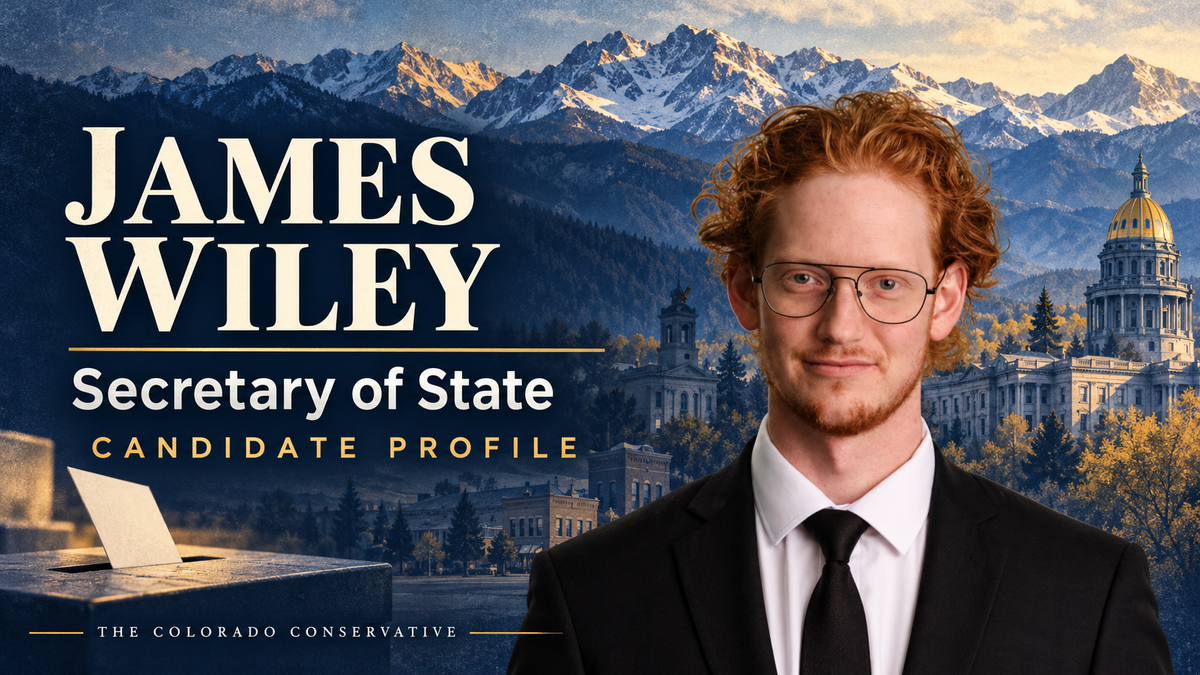
From the October 2026 issue of The Colorado Conservative.
James Wiley’s Commitment to Local Control, Transparent Elections, and Colorado Communities
From county-level election decisions to simpler business filings, James Wiley is proposing a more locally responsive Secretary of State’s Office. His campaign raises a consequential question: how can Colorado protect accurate, accessible elections while making the process more understandable to the people it serves?
A Candidate Who Starts by Listening
In Elbert County, James Wiley was speaking about something that matters well beyond a single election: whether Coloradans can understand, observe, and trust the public systems that operate in their name. His point was not limited to counting ballots. It was about the relationship between state government and the communities expected to carry out its rules.
I have met Wiley several times during this campaign, including at that recent Elbert County event. What impressed me was the attention he gave to local circumstances. He spoke about the county officials responsible for elections and about returning greater discretion to them, rather than treating every Colorado community as though it faces the same logistical challenges.
That perspective fits what I have observed of his approach to campaigning. Wiley has made a substantial effort to travel across the state, meet residents, and hear the concerns of different regions. I have seen a candidate willing to spend time listening before telling people what he believes should change. For an office serving all 64 counties, that effort is relevant.
Wiley, the Republican nominee for secretary of state, is offering a clear reform agenda: greater local discretion, more visible election procedures, a renewed emphasis on in-person voting and hand counting, and more accessible public records. His positions differ sharply from Colorado’s current election framework, but they are sufficiently specific to invite serious examination.
Democratic nominee Amanda Gonzalez, the Jefferson County clerk and recorder, makes a contrasting case for the accessibility and security of Colorado’s existing mail-ballot system. She emphasizes the practical experience of operating within that framework and warns that large changes could limit voting opportunities.
Both candidates speak about public trust. Wiley’s case begins with a proposition that appeals to a long Colorado tradition: government should be close enough to the people for them to see how it works and hold it accountable.

A Perspective Shaped by Liberty and Enterprise
Wiley’s outlook draws partly on an unusual upbringing. Born in Colorado Springs, he spent part of his youth in Kazakhstan after the Soviet Union’s collapse. In a September interview with Colorado Public Radio, he recalled his father teaching small-business and agricultural management as families and communities navigated an economy undergoing fundamental change.
Wiley describes that experience as formative in his views about freedom, private enterprise, and the importance of institutions people can trust. His interpretation is personal, but it helps explain why he repeatedly connects election integrity with individual liberty and local responsibility.
His education includes studies in management, marketing, and business administration at the University of Colorado Boulder and Colorado State University Pueblo, according to campaign biographical materials. His professional work has included financial services and marketing and technology consulting.
He also served as executive director of the Libertarian Party of Colorado and ran for Congress as a Libertarian in 2024 before becoming the 2026 Republican nominee for secretary of state. His political path reflects a long-standing focus on limited government and individual liberties, now pursued through a broader party coalition.
An Office That Touches More Than Elections
The secretary of state is Colorado’s chief elections officer, working with 64 county clerks who administer elections locally. The office also oversees business registrations, campaign-finance disclosures, notary records, and other public filings. In other words, its decisions affect voters, entrepreneurs, nonprofit organizations, and ordinary residents who need government records to be accurate and usable.
Wiley’s campaign invites a useful question: can the state make these systems easier for the public to understand without sacrificing the safeguards that make them reliable? He wants county administrators to have more room to respond to local realities and wants businesses to encounter fewer unnecessary administrative obstacles.
Those ideas would be implemented within real legal limits. The secretary of state cannot unilaterally rewrite every statewide voting requirement; significant changes may require legislation, appropriations, judicial review, and cooperation from county clerks. The distinction between a candidate’s objective and the authority to accomplish it matters to an honest examination of his plans.
Let Counties Be Counties
The most memorable part of Wiley’s Elbert County remarks, to me, was his willingness to question whether a single administrative model serves every part of Colorado equally well. I have heard him speak directly about returning greater decision-making authority to the counties that actually run elections.
The state stretches from densely populated Front Range communities to small towns on the Eastern Plains and mountain counties separated by long drives and difficult weather. Election offices operate under common legal requirements, but their staffing, geography, and service demands are not interchangeable.
Wiley argues that county clerks should have more flexibility to select administrative methods that fit those circumstances. That emphasis on local knowledge is a substantive part of his candidacy, not simply a slogan about limited government.
A rural clerk may need different practical arrangements from an administrator serving a major metropolitan population. Wiley’s proposal asks whether the state can preserve common protections while allowing more room for those operational judgments to be made locally.
As I understood his remarks, the goal is not to remove the requirement for accurate, lawful elections. It is to put more trust in the people closest to the daily responsibilities of conducting them.
The distinction between local flexibility and unequal voting standards is essential. State and federal law must continue to govern eligibility, ballot validity, voter protections, and accessibility. County flexibility would have to operate within those guarantees.
Wiley has described maintaining statewide standards for election security and transparency while increasing local control. Which procedures would be left to counties, how competing methods would be audited, and what resources clerks would receive all deserve fuller definition.
The promise of his approach lies in respecting different local needs. Its effectiveness would be measured by whether public confidence and administrative performance improve without weakening the protections every eligible voter should receive.
Showing Up Across Colorado
Beyond the policy details, Wiley’s willingness to travel and listen has been one of the qualities I have most appreciated in my encounters with him. He has made a concerted effort to meet people across the state rather than confining his campaign to its largest cities.
I have seen how much regional circumstances matter in Colorado. A statewide decision made in Denver can have very different consequences for a county clerk on the Eastern Plains, a resident in a mountain community, or a business owner on the Western Slope.

Wiley’s repeated conversations with residents place those differences near the center of his campaign. Rural voices deserve serious consideration alongside the needs of the Front Range, and an official responsible for coordinating all 64 counties benefits from knowing their circumstances.
From what I have observed personally, he has undertaken the demanding work of being present, hearing concerns, and explaining his positions. I see that willingness as a genuine commitment to public service, while recognizing that the success of his ideas ultimately depends on the details of their implementation.
Travel and accessibility are not substitutes for sound policy, but they can inform it. A statewide official who has listened carefully to local administrators and residents has a clearer opportunity to identify which rules work as intended and which create avoidable problems.
My encounters with Wiley leave me with the impression of a candidate who takes that obligation seriously. His effort to listen is one of the reasons his proposal for more locally responsive election administration deserves a careful, substantive hearing.
Making the Act of Voting More Visible
Wiley favors making in-person voting the primary method again, with absentee options for people whose circumstances prevent them from appearing in person. He has proposed an Election Day holiday and polling locations in familiar community settings. He argues that elections should feel like a shared civic responsibility rather than a procedure largely conducted out of public view.
His appeal is partly about confidence. When voters can see a clear process, observe election workers following known procedures, and understand how their votes are handled, he believes the system becomes easier to trust. He also points to mail ballots rejected because of signature-verification difficulties as an issue worth addressing.
Colorado now automatically mails ballots to active registered voters, who can mail them back, use secure drop boxes, or vote in person. Supporters of the current model emphasize convenience, established safeguards, and access for people whose work, health, or geography makes an in-person trip difficult.
Wiley’s proposal would require serious planning. More in-person voting could mean additional polling sites, trained workers, transportation options, and accommodations for residents with disabilities or demanding schedules. A state holiday would not necessarily provide paid time away from work for everyone.
The constructive test of his proposal is therefore practical: could Colorado make voting more observable and locally engaged while still providing every eligible voter a workable path to participate? Wiley has presented the direction of change; a detailed implementation plan would show how it could be delivered.
Putting Citizens Closer to the Count
Wiley also supports hand-counted paper ballots. He argues that residents should be able to see and understand the process by which ballots become results, with independent observers and a visible chain of custody. This is central to his view that confidence grows when election procedures can be explained without relying solely on specialized technology.
The case deserves to be evaluated on evidence. Human counts can be witnessed directly, but they also create risks of arithmetic and transcription mistakes, increased staffing requirements, and delayed reporting. Electronic tabulation provides speed and is subject to testing and audits, but the underlying systems must remain open to independent scrutiny.
Colorado already uses post-election risk-limiting audits, including bipartisan procedures that check tabulated results against paper ballots. Wiley’s proposed alternative would need to demonstrate accuracy, transparency, accessibility, and manageable costs in comparison with those established practices.
Accurate Voter Rolls and Verifiable Claims
Another Wiley priority is more aggressive maintenance of voter-registration records. He argues that outdated, duplicate, or otherwise ineligible entries undermine confidence in the system and has discussed a sweeping approach to refreshing the rolls. His opponents caution that broad removal and re-registration requirements could prevent eligible residents from voting.
There is common ground in the underlying objective: accurate voter rolls matter. People move, die, change names, and update their registrations. But an outdated entry does not by itself demonstrate a fraudulent ballot, and any claim of unlawful voting requires evidence rather than inference.
Wiley has also pursued election-related litigation against Secretary of State Jena Griswold. In his September Colorado Public Radio interview, he acknowledged that seven lawsuits he discussed ultimately failed. That history is relevant when assessing the effectiveness of legal strategies, even while voters can separately consider his stated reform goals.
The strongest implementation plan would set measurable standards for record accuracy, provide lawful notice and opportunities to correct errors, protect eligible voters against improper removal, and publish audit results that the public can examine.
Innovation for Business and Public Records
Wiley’s approach to technology is more nuanced than his opposition to electronic vote tabulation might suggest. He supports applying technology to other operations of the secretary of state’s office, particularly where it can simplify transactions or make records easier to verify.
He has discussed blockchain-based verification for business and notary records and automatic business-registration renewals. His stated goal is to reduce friction for people starting or maintaining companies while making the history of public filings more readily traceable.
These are proposals, not demonstrated solutions. A digital ledger cannot guarantee the accuracy of information originally submitted, and modernization has costs and privacy and security implications.

Nonetheless, the focus on business services is notable in a race that often concentrates almost exclusively on voting.
For entrepreneurs and small-business owners, efficient records and clear administrative rules are not abstract matters. Wiley is making the case that the Secretary of State’s Office should help people complete required filings reliably and with minimal unnecessary complication.
A Different Approach: Amanda Gonzalez
Amanda Gonzalez brings a different professional foundation. As Jefferson County clerk and recorder, she has directly administered elections using Colorado’s existing voting framework. She is also an attorney and has argued for maintaining broad access to mail ballots.
Gonzalez emphasizes established procedures, multiple ballot-return options, and the accessibility of voting from home. She opposes sweeping voter-roll removals, arguing that they could exclude eligible voters. Her approach is focused on strengthening the current system rather than replacing major elements of it.
The difference is substantive. Wiley brings experience in business, technology, political organizing, and a sustained critique of election administration. Gonzalez brings direct county election-management experience and legal expertise. Their backgrounds inform distinct judgments about how public trust is best earned.
Wiley asks whether the state should rethink the structure of the system itself. Gonzalez asks how to reinforce a structure she considers generally reliable. Neither the desire for reform nor familiarity with the current model substitutes for specific evidence about costs, safeguards, and voter access.
A Plan Measured by Results
Wiley’s message is grounded in an understandable civic aspiration: residents should have confidence that their elections are accurate, their public records are dependable, and their county officials have the tools to do their jobs. Those are measurable responsibilities, not merely campaign themes.
For his proposals, meaningful benchmarks would include counting accuracy, audit outcomes, the cost and staffing of local procedures, the number of eligible voters successfully served, and transparent reporting of mistakes. For Gonzalez’s approach, the same standard applies: current safeguards must continue to be independently tested and improved when weaknesses appear.
Whoever becomes secretary of state must serve Democrats, Republicans, unaffiliated voters, and every other eligible resident equally. That obligation is especially important for reforms affecting ballot access or public confidence in outcomes.
Public skepticism should not be confused with established misconduct. Confidence grows when officials provide accurate information, investigate real errors, correct shortcomings, and communicate what the evidence actually shows—even when the findings do not support a preferred political narrative.
A Clear Vision, and Questions Worth Answering
Wiley is offering Coloradans an identifiable alternative: a Secretary of State’s Office that gives counties greater operational discretion, brings citizens closer to the counting process, and treats transparency and local service as central responsibilities. His travel and public engagement reinforce the county-focused philosophy he has described.
Gonzalez proposes continuity with Colorado’s mail-ballot model, backed by her experience administering elections and her emphasis on accessibility. The candidates therefore present materially different approaches to the same responsibilities.
The choices at issue are concrete. How should Colorado weigh locally visible procedures against the convenience of voting by mail? How can counties gain flexibility without introducing inconsistent protections? What investments would be required to make any revised approach accurate, practical, and secure?
I have met Wiley often enough to appreciate his persistence and his interest in hearing from the people affected by state decisions. His candidacy places local control and public verification squarely in the conversation. The ultimate measure of either candidate’s proposals will be whether they protect eligible voters, produce accurate results, and make the Secretary of State’s Office accountable to the public it serves.
Editorial Disclosure
This is an independent candidate profile prepared for The Colorado Conservative. It is not a formal endorsement of James Wiley, Amanda Gonzalez, or any other candidate. The publisher has met Wiley several times. Firsthand impressions are identified as personal observations; independently reported positions, campaign claims, and policy analysis are distinguished in the text.
Descriptions of Wiley’s county-control proposal reflect both his published statements and the publisher’s understanding of remarks heard in person. The proposed changes would remain subject to applicable law, practical constraints, and, where necessary, legislative action.
Sources and Research
Colorado Secretary of State, TRACER candidate record: https://tracer.sos.colorado.gov/PublicSite/SearchPages/CandidateDetail.aspx?SeqID=67508&Type=CA James Wiley campaign biography: https://wileyforcolorado.com/bio Colorado Public Radio, September 16, 2026, interview with James Wiley: https://www.cpr.org/2026/09/16/republican-secretary-of-state-candidate-james-wiley/Colorado Public Radio, September 16, 2026, interview with Amanda Gonzalez: https://www.cpr.org/2026/09/16/democratic-secretary-of-state-candidate-amanda-gonzalez/Colorado Newsline, 2026 election candidate comparison: https://coloradonewsline.com/voter-guides/contests/2026-general-colorado-sos/KRDO, June 15, 2026, James Wiley candidate Q&A: https://krdo.com/2026-secretary-of-state-race/2026/06/15/james-wiley/Colorado Politics, October 10, 2026, secretary of state debate: https://www.coloradopolitics.com/2026/10/10/candidates-for-top-election-post-split-on-mail-voting-election-trust/Colorado Secretary of State, November 20, 2025, risk-limiting audit release: https://content.govdelivery.com/accounts/COSOS/bulletins/3fb78d4