Proposition NN - State Public K–12 Education Funding

OFFICIAL BALLOT QUESTION
“Shall state investment in K-12 public education increase two percent each year for the next ten years, with investments used to increase teacher pay, improve teacher retention, lower class sizes, and increase access to career and technical courses, without raising taxes but instead funded by raising the annual limit on state fiscal year spending only by the amount spent on public K-12 education as a voter-approved revenue change, and requiring an annual publicly released, independent audit to show how the new investments are spent?”
Source Senate Bill 26-135, final act; Colorado General Assembly
NEUTRAL OVERVIEW
Proposition NN asks voters to authorize Colorado to retain revenue above the TABOR limit in an amount tied to state public K–12 education funding. It does not raise a tax rate. When the state collects revenue above the existing limit, however, retained money would otherwise be available for TABOR refunds or other refund mechanisms. The final fiscal note projected reduced refunds of $329.9 million in FY 2026–27 and $521.0 million in FY 2027–28 under its then-current forecast.
The measure creates a “positive factor” that adds up to 2 percent of the program foundation in the first year and compounds annually for ten years. The resulting level continues after the ten-year buildup. A district may spend its positive-factor distribution only on teacher pay, teacher retention, lower class sizes, or career and technical courses. The broader retained-revenue authorization is not limited to those four uses: after paying the positive factor, remaining money can support school and disability services, additional contact hours, child care, full-day preschool, and other school-readiness programs under the statutory order of allocation.
The State Auditor must report how much excess revenue was retained and describe how it was spent. Districts must post positive-factor expenditures in a free, downloadable, sortable format. Those are real transparency provisions. They do not require a performance audit, a minimum share for teacher compensation, a class-size baseline or target, a retention target, a CTE-access target, an administrative-cost cap, or an outcome test that controls whether retention continues.
INITIATIVE AT A GLANCE
|
Question |
Plain-English answer |
|
Does the tax
rate rise? |
No. The measure
changes the TABOR revenue limit and retention authority, not a tax rate. |
|
What happens to
refunds? |
Forecast
refunds may be smaller because the state may keep revenue above today’s
limit. |
|
What is the
K–12 increase? |
Up to 2% of
program foundation in year one, compounded annually for ten years; the
built-up amount continues afterward. |
|
What may
districts do with that increase? |
Increase
teacher pay, improve retention, lower class sizes, or expand career and
technical courses. |
|
Is all retained
money confined to those four uses? |
No. Remaining
account money can flow to other school and children’s programs listed in the
act. |
|
What audit is
required? |
An annual
report of the amount retained and a description of expenditures—not a
required audit of results. |
|
Editorial
position |
NO until
Colorado completes a public ten-year money-and-results audit and adopts
exact, enforceable teacher and student benefit metrics. |
THE PROPONENT CASE
Supporters argue that Colorado schools face real pressure from teacher shortages, high housing costs, difficult working conditions, special-education needs, and uneven access to career programs. A predictable multiyear increase can help districts raise pay, keep experienced educators, add staff where classes are crowded, and build technical courses that require equipment and employer partnerships.
They also note that voters decide the TABOR change directly; no tax rate rises; the district-level positive-factor uses are limited in law; the new money must supplement rather than replace ordinary formula funding; districts must post expenditures; and the State Auditor must publish an annual report. In their view, those safeguards are sufficient and delaying help imposes its own cost on teachers and students.
THE OPPONENT CASE
Opponents agree that teachers and students need support but argue that the state has not reconciled the substantial growth in funding already provided with staffing, classroom conditions, and academic results. They object to authorizing another continuing TABOR retention mechanism before an independent performance audit traces prior increases from the state to districts, schools, classrooms, compensation, administration, facilities, benefits, and student services.
They also argue that the ballot wording emphasizes four popular promises even though not every retained dollar is limited to those purposes. The measure does not reserve a stated percentage for teacher pay, define “lower class sizes,” publish district baselines, cap overhead, require improvement, or suspend the mechanism when results fall short. An expenditure description proves where money was booked; it does not prove that a teacher received support or a student received a better education.
OFFICIAL MEASURE INFORMATION
|
Item |
Official listing |
|
Measure type |
Legislatively
referred statutory measure (SB 26-135) |
|
Approval
required |
Majority vote |
|
Election |
November 3,
2026 |
|
Prime sponsors |
Sen. Jeff
Bridges; Sen. Cathy Kipp; Rep. Jennifer Bacon; Rep. Meghan Lukens |
|
Registered in
support |
Yes for
Colorado Kids |
|
Registered in
opposition |
A Brighter
Colorado; Affordable Colorado; Let’s Go Colorado; Keep Colorado Affordable;
Don’t Price Us Out |
THE COLORADO CONSERVATIVE UNFORTUNATELY
RECOMMENDS NO
THE PUBLIC RECORD: FUNDING, PEOPLE, AND RESULTS
The data does not support every popular claim on either side. It supports a narrower and more consequential conclusion: Colorado has materially increased K–12 formula resources, teachers remain under intense local pressure, and the state still does not give voters one clear, statewide reconciliation showing how added dollars changed classroom staffing, workload, compensation, and student results. The following comparisons use official Colorado and federal series and state their limits.
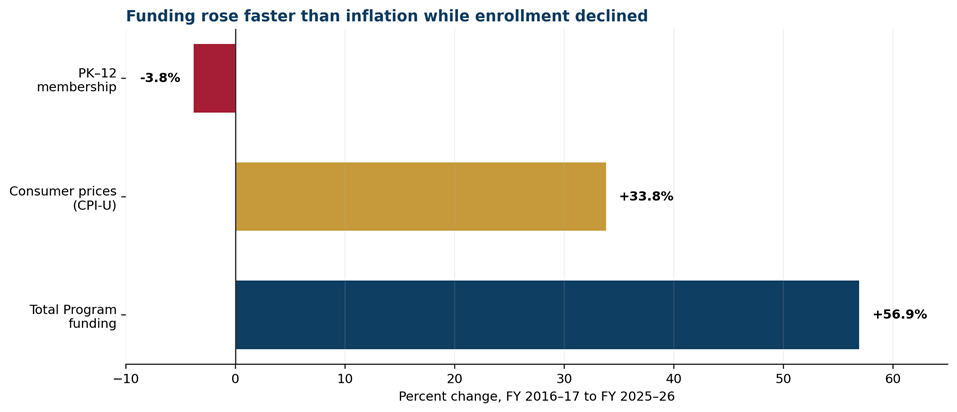
Total Program funding rose from $6.373 billion to $9.998 billion. PK–12 membership fell from 905,019 to 870,793. The CPI line is the U.S. CPI-U annual-average change used only as a broad purchasing-power benchmark.
This comparison does not prove that 23 percentage points above inflation were wasted. Special education, employee benefits, transportation, security, facilities, rural cost pressures, and other obligations can grow differently from consumer prices. It does prove that “schools received no meaningful increase” is not an adequate statewide explanation. The state should reconcile the increase by function and result before asking voters for another open-ended revenue change.
PURCHASING POWER PER PUPIL
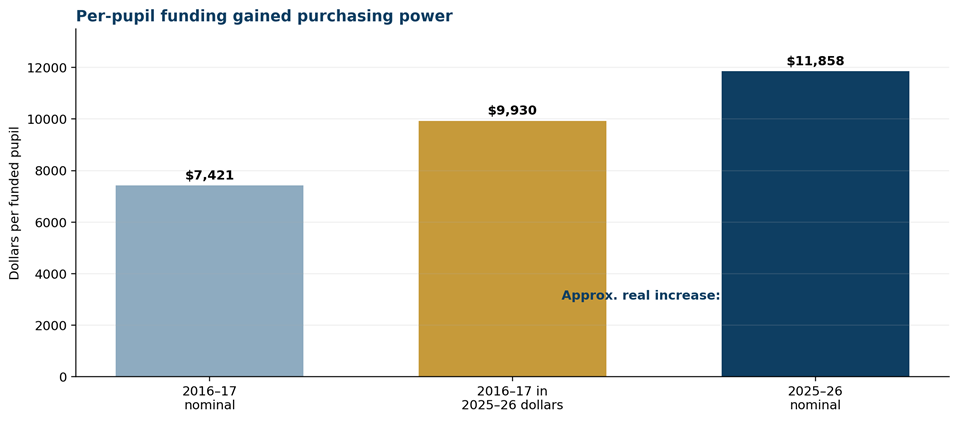
Average Total Program funding increased from $7,421 to $11,858 per funded pupil. Adjusting the earlier figure by the same CPI benchmark yields roughly $9,930 in 2025–26 dollars—an approximate 19% real increase.
Total Program is not the same as every education dollar, nor is per-pupil formula funding the same as a teacher’s paycheck. The distinction matters. Colorado can simultaneously have a rising statewide funding formula and teachers who feel underpaid, overworked, or unsupported in particular districts. That tension is exactly why a source-to-classroom audit is needed: voters should be able to see which costs absorbed the growth, district by district, and which choices improved classroom conditions.
WHAT THE MONEY TRAIL MUST RECONCILE
|
Ledger category |
Required public answer |
|
Teacher
compensation |
Salary,
benefits, stipends, planning time, vacancies, turnover, and real-pay change
by district. |
|
School
leadership |
Principal and
assistant-principal FTE, responsibilities, school counts, and management
spans. |
|
Central
administration |
Executive,
finance, HR, legal, communications, consulting, and compliance spending and
FTE. |
|
Student support |
Special
education, counselors, nurses, mental health, transportation, safety, and
interventions. |
|
Facilities and
debt |
Construction,
maintenance, leases, debt service, energy, and deferred maintenance. |
|
Classroom
delivery |
Actual
class-size distributions by grade and subject—not merely a statewide
pupil–teacher ratio. |
|
Results |
CTE access and
completion, retention, attendance, achievement, graduation, and postsecondary
readiness. |
TEACHER PAY AND STAFFING: WHAT THE VERIFIED SERIES SHOWS
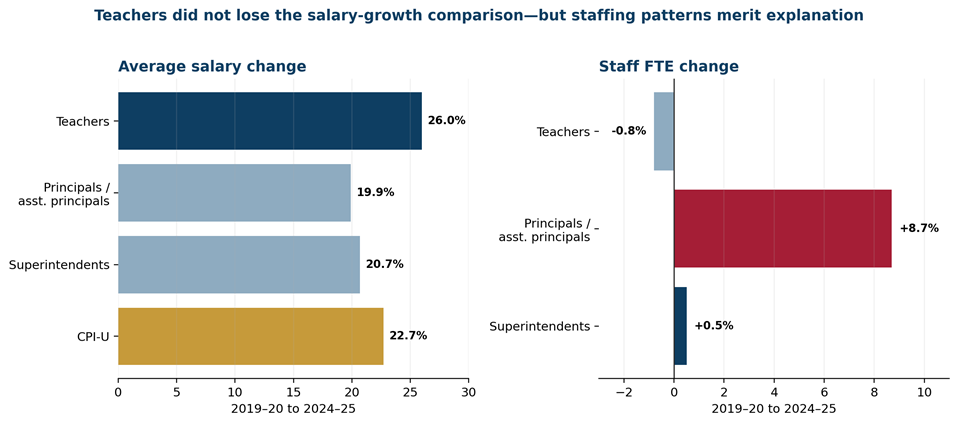
CDE average salary equals total salary in the category divided by category FTE. Teacher average salary rose from $57,746 to $72,781; principal/assistant-principal salary from $93,927 to $112,580; superintendent salary from $129,426 to $156,189. CPI-U rose 22.7%.
This result corrects an assumption in the earlier draft. In the verified five-year comparison, average teacher salary grew faster than the principal and superintendent averages and modestly faster than CPI. It would therefore be inaccurate to say statewide administrative salaries outpaced teacher salaries during this period. Accuracy strengthens the case for accountability: the unanswered question is not a slogan about pay rates, but why teacher staffing slipped while principal/assistant-principal FTE rose 8.7%, what duties that increase reflects, and whether the staffing mix improved teaching conditions.
Principals are school-level educators and managers, not automatically “bureaucracy.” A rise in their FTE may reflect new schools, student needs, safety duties, instructional leadership, or compliance burdens. It may also reveal organizational growth that deserves scrutiny. The figures establish a question; they do not establish waste. A genuine audit must separate school leadership from central-office administration and compare responsibilities, school counts, and outcomes.
CLASS SIZE: THE STATEWIDE CLAIM REQUIRES BETTER DATA
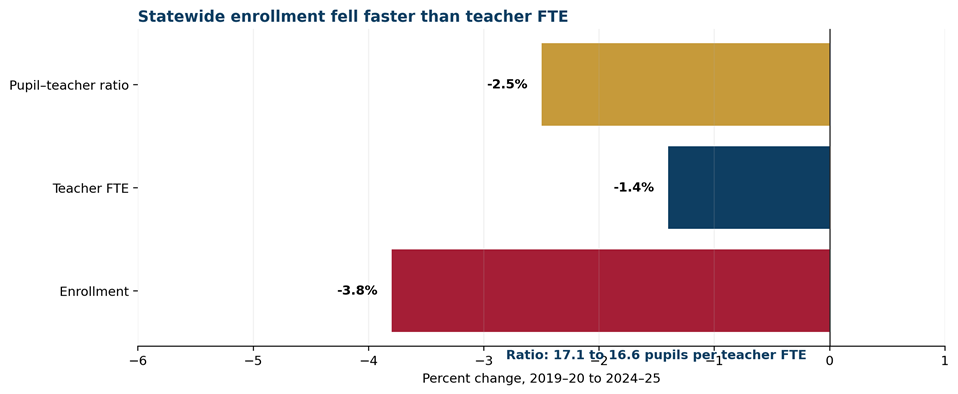
CDE’s school-level files imply a statewide pupil–teacher ratio of about 17.1 in 2019–20 and 16.6 in 2024–25. Enrollment and teacher FTE in this series both fell, but enrollment fell faster.
A pupil–teacher ratio is not an average class size. It divides enrollment by teacher FTE and can include educators who do not lead a single scheduled classroom. Actual class sizes vary by grade, subject, district, school, period, and course. The statewide ratio moved modestly in the favorable direction, so this article does not claim that Colorado class sizes rose statewide. Teachers reporting crowded rooms may still be describing real local conditions that a statewide average hides.
Proposition NN promises to “lower class sizes” but does not define the baseline, the measurement method, the grades or courses covered, the target, the reporting unit, or the consequence for failure. The state should publish distributions—such as the share of core classes above locally disclosed thresholds—before and after funding. Without that, a district can spend money under an allowed label without proving that a single crowded classroom became smaller.
STUDENT OUTCOMES: MIXED, NOT A VERDICT ON TEACHERS
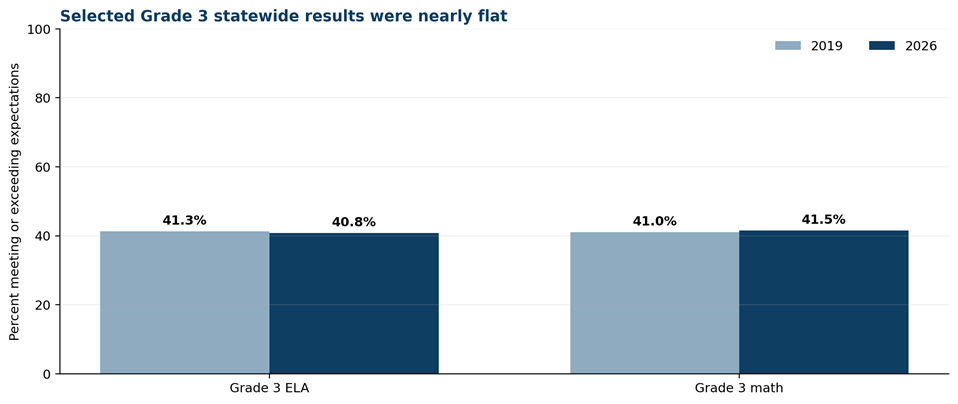
Selected statewide Grade 3 CMAS results changed little between 2019 and 2026. Pandemic disruption and participation differences limit simple trend claims; these figures are descriptive, not causal.
Statewide test results cannot isolate the effect of funding. Student poverty, disability, English-language status, attendance, family circumstances, curriculum, leadership, pandemic disruption, and local implementation all matter. Nor should uneven results be used to blame teachers, who do not control many of those conditions. The relevant accountability question is narrower: when government asks for a new recurring revenue mechanism, what measurable marginal improvement does it promise to purchase, and how will the public know whether that promise was kept?
Some 2026 results improved and others declined. The state should report a balanced dashboard rather than choose one score to celebrate or condemn. Funding plans should identify the students to be served, the intervention, baseline, target, timetable, cost, and independent evaluation method.
WHY WE RECOMMEND NO
Teachers are not the problem. Colorado’s educators carry the daily consequences of decisions made far from their classrooms. They teach, counsel, de-escalate, document, adapt, and keep showing up while costs rise and public debate reduces their work to a budget line or test score. The Colorado Conservative has not forgotten them. Students and teachers are the first people this system must serve—not the last people asked to absorb its failures.
Compassion requires candor. The statewide record does not show that teacher salary growth lagged the comparable administrator salary averages from 2019–20 through 2024–25. It also does not show a worsening statewide pupil–teacher ratio. We will not manufacture a case. It does show large formula-funding growth, declining enrollment, slightly fewer teacher FTE, materially more principal and assistant-principal FTE, and academic results that remain uneven. Those facts demand explanation.
The state has not earned another blank check. From FY 2016–17 to FY 2025–26, Total Program funding rose about 57 percent while the broad consumer-price benchmark rose about 34 percent and PK–12 membership declined about 4 percent. Per-pupil formula funding increased in real terms. Yet voters still cannot open one authoritative ledger that connects each major funding increase to teacher compensation, staffing, class-size distributions, student services, central administration, facilities, debt, and measured results across every district.
“Missing” should mean unreconciled—not stolen. This publication is not alleging that billions vanished or that educators diverted them. Public education legitimately pays for health benefits, pensions, special education, transportation, buildings, utilities, security, technology, counselors, nurses, compliance, and services for students with greater needs. But legitimate categories are not a substitute for a clear reconciliation. If government cannot explain the full path in language voters can test, the money trail is publicly incomplete.
The ballot question sells four promises; the statute authorizes more. District positive-factor money is restricted to teacher pay, retention, class size, and career and technical education. The retained-revenue account, however, can also support disability services, school services, additional contact hours, child care, full-day preschool, and school-readiness programs after the positive factor is paid. Many of those purposes are worthy. They are still broader than the four classroom-centered promises most voters will remember.
EDITORIAL REVIEW CONTINUED
The audit is too narrow and too late. The State Auditor must report the amount retained and describe expenditures. Districts must post positive-factor spending. Those provisions deserve credit, but they primarily answer “where was it booked?” They do not require an independent determination of whether teacher pay meaningfully improved, turnover fell, actual classes shrank, CTE access expanded, or student outcomes changed. More importantly, voters grant the authority first and receive the reports afterward. Colorado should audit prior increases before requesting another dollar.
There is no exact teacher guarantee. The measure does not assign a minimum percentage to teacher compensation, distinguish salary from benefits, require pay to rise faster than inflation, protect planning time, or target shortage subjects and hard-to-staff communities. “Increase teacher pay” can be true in an accounting sense while the increase is too small, uneven, temporary, or offset by higher benefit costs to change a teacher’s life.
There is no exact student guarantee. The measure does not define class size, set grade-level targets, identify a minimum number of new CTE seats, require equitable rural access, or tie continuation to attendance, graduation, achievement, or career credential results. A promise without a baseline, target, deadline, and remedy is an aspiration, not an enforceable plan.
TABOR is not a technical footnote. Proposition NN asks voters to raise the state revenue limit by an amount tied to public K–12 funding. No tax rate rises, but projected refunds can fall. The positive factor builds for ten years and the resulting funding level continues. Voters should approve that trade only when the plan is precise enough to show who benefits, by how much, by when, and what happens if government fails.
The proper sequence is audit, plan, then funding. First, reconcile the last decade of state and local increases, fees, federal aid, compensation, staffing, administration, benefits, facilities, and outcomes. Second, publish district baselines and statewide definitions. Third, identify the exact teacher and student gains the next dollar will purchase. Fourth, require an independent performance audit, corrective action, and a sunset or renewal vote. Only then should Colorado ask taxpayers for continuing retention authority.
Our conclusion. A NO vote is not a vote against teachers or students. It is a demand that government stop using their needs as a substitute for a complete plan. We stand with educators by insisting that promised money reach educators; we stand with students by insisting that spending change their educational experience; and we stand with taxpayers by refusing another continuing allocation until the existing money trail is fully established. Vote NO on Proposition NN, then return with an audited, targeted, measurable proposal worthy of the people it claims to serve.
HOW WE REACHED THE SCORES
Each category uses five tests worth 0 to 10 points. Anchors are fixed: 0 means clear harm or total failure; 2 means a material weakness; 5 means mixed or neutral evidence; 8 means a clear benefit with workable safeguards; and 10 means an exceptional benefit with strong controls. Intermediate whole numbers are used only when the evidence falls between anchors.
Star conversion is fixed: 0–4 points earns no star; 5–14 earns one; 15–24 earns two; 25–34 earns three; 35–44 earns four; and 45–50 earns five.
|
Category |
Points |
Stars |
|
Fiscal
Responsibility |
14/50 |
★☆☆☆☆ |
|
Limited
Government |
12/50 |
★☆☆☆☆ |
|
Individual
Liberty |
24/50 |
★★☆☆☆ |
|
Institutional
Integrity |
22/50 |
★★☆☆☆ |
|
Long-Term
Colorado Impact |
27/50 |
★★★☆☆ |
FISCAL RESPONSIBILITY 14 OF 50 ★☆☆☆☆
The goals are important, but the measure grants continuing revenue authority before a backward-looking performance audit and without precise outcome conditions.
|
Test |
Pts |
Evidence and reason |
|
Prior-spending
reconciliation |
1 |
No required
audit reconciles the preceding decade of funding, staffing, compensation,
overhead, and results. |
|
Taxpayer-cost
control |
2 |
No rate rises,
but projected TABOR refunds decline and the authority is not capped at the
positive-factor cost. |
|
Teacher-target
precision |
3 |
Teacher pay and
retention are allowed uses, but no minimum share or measurable compensation
standard is set. |
|
Student-target
precision |
3 |
Class size and
CTE are named, but no baseline, target, deadline, or remedial rule is
defined. |
|
Fiscal
reporting |
5 |
Annual
reporting and sortable district expenditures are useful, though focused on
spending rather than value. |
|
Metric total |
14 |
★☆☆☆☆ |
LIMITED GOVERNMENT 12 OF 50 ★☆☆☆☆
The measure expands continuing state retention and earmarking, with few built-in limits on duration or results.
|
Test |
Pts |
Evidence and reason |
|
Scope of
retention |
1 |
Retention
authority is tied to state public K–12 funding and can exceed the amount
required for the four highlighted district uses. |
|
Duration |
1 |
The built-up
positive factor continues after ten years; the retention change has no voter
reauthorization requirement. |
|
Budget
flexibility |
2 |
A continuing
earmark reduces the ability to compare education increments with refunds and
other priorities. |
|
Local
discretion |
5 |
Districts
choose among four positive-factor uses, which respects differing local needs. |
|
Reversibility |
3 |
As statutory
law it may be amended, but the measure itself contains no sunset or automatic
review gate. |
|
Metric total |
12 |
★☆☆☆☆ |
INDIVIDUAL LIBERTY 24 OF 50 ★★☆☆☆
Voters consent directly and teachers and students may benefit, but taxpayers may receive smaller refunds and families receive no enforceable service entitlement.
|
Test |
Pts |
Evidence and reason |
|
Direct voter
consent |
8 |
Colorado voters
decide the TABOR revenue change at a statewide election. |
|
No rate
increase |
8 |
The measure
does not raise a tax rate. |
|
Refund impact |
2 |
Retained
revenue can reduce money otherwise returned through TABOR refunds. |
|
Family choice
and access |
3 |
CTE access may
expand, but the measure sets no portable benefit or guaranteed seat for an
individual student. |
|
Disclosure to
voters |
3 |
The ballot
states the broad purpose but not the full allocation structure or official
forecast refund amounts. |
|
Metric total |
24 |
★★☆☆☆ |
INSTITUTIONAL INTEGRITY 22 OF 50 ★★☆☆☆
The measure improves expenditure transparency but does not require a performance audit or consequences for failure.
|
Test |
Pts |
Evidence and reason |
|
Public
expenditure data |
8 |
District
positive-factor expenditures must be free, downloadable, and sortable. |
|
Independent
reporting |
6 |
The State
Auditor reports retained and spent amounts, providing an independent public
record. |
|
Outcome
verification |
2 |
The audit
requirement does not mandate evaluation of teacher, class-size, CTE, or
student results. |
|
Allocation
clarity |
3 |
The statutory
order is visible, but the ballot’s four promises do not describe every
authorized downstream use. |
|
Enforcement and
remedies |
3 |
No clawback,
corrective-action deadline, performance gate, or renewal vote is tied to poor
results. |
|
Metric total |
22 |
★★☆☆☆ |
LONG-TERM COLORADO IMPACT 27 OF 50 ★★★☆☆
Sustained investment could materially help schools, but weak targeting and indefinite fiscal effects create long-term risk.
|
Test |
Pts |
Evidence and reason |
|
Teacher-workforce
potential |
7 |
Flexible pay
and retention funding could help districts address real workforce pressures. |
|
Student-opportunity
potential |
7 |
Smaller classes
and CTE expansion can be valuable when targeted and measured. |
|
Equity and
rural reach |
5 |
Formula
distribution may reach the state broadly, but the measure sets no exact
access or need-based result. |
|
Durability of
benefit |
5 |
Compounded
funding is durable, but durability is not conditioned on successful delivery. |
|
Adaptability
and opportunity cost |
3 |
The continuing
mechanism reduces future refund and budget flexibility without a scheduled
voter reset. |
|
Metric total |
27 |
★★★☆☆ |
OVERALL RESULT
|
Five-category total |
Normalized score |
Overall stars |
Recommendation |
|
99/250 |
20/50 |
★★☆☆☆ |
NO |
The measure earns credit for voter consent, no tax-rate increase, restricted district uses, expenditure reporting, and the potential to help educators and students. It fails the central accountability test because it asks voters to authorize a continuing TABOR change before reconciling prior spending and without exact benefit metrics, performance gates, or a required renewal decision.
WHAT WE WILL HOLD GOVERNMENT ACCOUNTABLE FOR
Whatever the election result, this publication will follow the money and the promised results. We will treat support for teachers, students, and taxpayers as one obligation—not three competing slogans.
BEFORE ANY FUTURE EDUCATION REVENUE REQUEST
1. Complete a ten-year source-to-use audit. Reconcile state formula money, categorical aid, federal funds, local overrides, bonds, fees, grants, and other material revenue with expenditures by district, school, function, and object.
2. Separate the categories voters actually need. Report teacher salary and benefits; other instructional staff; principals; central administration; student support; special education; transportation; facilities; debt; contracts; technology; security; and unspent balances.
3. Explain staffing composition. Publish teacher, principal, central-office, counselor, nurse, paraprofessional, and support FTE; school counts; enrollment; vacancies; turnover; and management spans using consistent definitions.
4. Publish actual class-size distributions. Report scheduled class size by grade, subject, school, and district, including the number and share of classes above disclosed thresholds. Do not substitute pupil–teacher ratios.
5. Reconcile every prior promise. For each tax increase, override, fee, special fund, or major appropriation sold as educational relief, state the promise, amount collected, amount spent, recipient, result, and unresolved audit finding.
IF PROPOSITION NN PASSES
1. Track the taxpayer effect. Publish the amount retained, the TABOR refund reduction by refund mechanism and income tier, and the total increase in the revenue limit each year.
2. Keep the accounts separate. Show positive-factor distributions apart from every other children’s-account expenditure, property-tax reimbursement adjustment, interest earning, transfer, and year-end balance.
3. Measure teacher compensation precisely. Report salary, benefits, stipends, planning time, vacancy, turnover, and inflation-adjusted change. State the exact share of new money reaching classroom educators.
4. Measure retention honestly. Use a consistent statewide definition; separate retirement, relocation, promotion, dismissal, and voluntary exit; and compare funded interventions with matched baselines where feasible.
5. Verify class-size results. Publish before-and-after scheduled class distributions and identify which positions reduced which classes at what annual cost.
6. Verify CTE access and completion. Track seats, waitlists, course availability, credentials, work-based learning, completion, geography, student subgroup access, and cost per added successful participant.
7. Audit overhead and supplanting. Test whether new money supplemented existing support, disclose administrative and consulting costs, and identify any ordinary spending shifted away after the measure passed.
8. Require one-, three-, five-, and ten-year reviews. Compare spending and results with the original baseline. Recommend corrective action, statutory revision, suspension, or repeal when benefits are not demonstrable and proportionate.
PRIMARY SOURCES AND METHODS
• Colorado General Assembly, SB 26-135 bill page, final act, bill summary, and final fiscal note (August 10, 2026): leg.colorado.gov/bills/sb26-135
• Colorado Legislative Council Staff, 2026 Colorado School Finance Handbook: content.leg.colorado.gov/sites/default/files/School%20Finance%20Handbook%202026_0.pdf
• Colorado Department of Education, Pupil Membership Statistics archives: ed.cde.state.co.us/cdereval/pupilmembership-statistics/data-insights-resources-archives
• Colorado Department of Education, Staff Statistics archives, including statewide teacher, principal/assistant-principal, superintendent, and pupil–teacher-ratio files for 2019–20 and 2024–25: ed.cde.state.co.us/cdereval/staffstatistics/data-insights-resources-archives
• Colorado Department of Education, CMAS Data and Results, statewide 2019–2026 Grade 3 ELA and mathematics results: cde.state.co.us/assessment/cmas-dataandresults
• U.S. Bureau of Labor Statistics, CPI-U annual averages for broad inflation comparison: bls.gov/cpi/tables/supplemental-files/home.htm
• Colorado Secretary of State, 2026 ballot-measure committee listings: coloradosos.gov/pubs/elections/Initiatives/ballot/contacts/2026.html
METHOD NOTES
Dollar figures are nominal unless identified as inflation-adjusted. The 2016–17-to-2025–26 real per-pupil comparison uses one CPI-U annual-average benchmark and is approximate. CDE salary averages are salary totals divided by category FTE. Salary categories do not measure benefits or total compensation. Pupil–teacher ratios are not class-size measures. Test-score comparisons are descriptive and do not establish causation. Percentages may not sum exactly because of rounding.
APPENDIX: SENATE BILL 26-135 — FINAL ACT TEXT
Exact text reproduced from the supplied source document; official final act available from the Colorado General Assembly.
SENATE BILL 26-135
BY SENATOR(S) Bridges and Kipp, Amabile, Benavidez, Coleman, Cutter, Danielson, Daugherty, Exum, Gonzales J., Hinrichsen, Jodeh, Kolker, Lindstedt, Marchman, Mullica, Rodriguez, Snyder, Sullivan, Weissman, Wallace;
also REPRESENTATIVE(S) Bacon and Lukens, Boesenecker, Camacho, Carter, Duran, Goldstein, Hamrick, Joseph, Lieder, Lindsay, Martinez, McCormick, Nguyen, Paschal, Phillips, Rydin, Smith, Stewart R., Titone, Velasco, Willford, Clifford, English, Espenoza, Froelich, Gilchrist, Jackson, Mauro, Ricks, Rutinel, Stewart K., Story, McCluskie.
CONCERNING STATE PUBLIC EDUCATION K-12 FUNDING, AND, IN CONNECTION THEREWITH,
INCREASING APPROPRIATIONS FOR STATE PUBLIC EDUCATION K-12 FOR TEN YEARS, ALLOWING THE STATE TO RETAIN AN AMOUNT OF STATE REVENUE IN EXCESS OF THE LIMITATION ON STATE FISCAL YEAR SPENDING EQUAL TO STATE PUBLIC K-12 EDUCATION FUNDING, AND SUBMITTING A BALLOT QUESTION TO THE REGISTERED ELECTORS OF THE STATE.
Be it enacted by the General Assembly of the State of Colorado:
SECTION 1. Legislative declaration. (1) The general assembly finds and declares that:
Public education is the bedrock of Colorado's democracy, fundamental to individual
opportunity, the underpinning of thriving communities, and the key to Colorado's economic prosperity and future;
(b) Wise and adequate investment in Colorado's schools is essential to maintaining and improving the competitiveness of Colorado and its students;
(c) The money invested in Colorado's public schools has a return on investment that has long been recognized as among the nation's highest;
(d) An increase in the rates of K-12 graduation, the earning of industry certifications, and the earning of associates degrees demonstrate the effectiveness of Colorado's investment in public schools;
(e) Research demonstrates that increasing school funding results in long-term increases in graduation rates and lifetime wages, prevents crime, and lowers incarceration rates;
(f) Educators and support staff in every school district and charter school across Colorado make invaluable contributions to their schools, districts, and communities by dedicating their time, talents, and out-of-pocket money to their students, despite Colorado ranking near the bottom of starting teacher pay and having the largest teacher pay penalty in the nation;
(g) Teachers, counselors, para professionals, bus drivers, and essential support staff are leaving their professions because salaries have not kept up with housing, healthcare, and cost of living;
(h) Students are learning in overcrowded classrooms and in schools with fewer mental health counselors, opportunities for special education support, and programs that support their ability to develop into healthy, productive adults;
(i) Working class, multilingual, and rural communities are hit hardest by chronic school underfunding;
(j) In January 2025, the legislature received the reports and PAGE 2-SENATE BILL 26-135 recommendation of the two commissioned adequacy studies: "Equity and Adequacy of Colorado School Funding - A Cost-Modeling Approach", by the American institutes for research, and "Colorado Input-Based Financial Adequacy Study Report", by Augenblick, Palaich and Associates, Inc;
(k) The adequacy studies found that, were Colorado schools funded fully and fairly, every student would have the individual attention they need from teachers, counselors, health professionals, tutors, and support staff to succeed and thrive; every teacher would have a reasonable workload, professional development and coaching, and a salary that would allow them to live where they work; and every community would enjoy the benefit of vibrant public schools, a high-quality workforce, and an engaged citizenry;
(l) Colorado's fiscal constraints and potential of federal funding cuts to education, medicaid, nutrition, human services, and other critical programs threaten the sustainability and adequacy of school funding in Colorado and to deplete the state education fund;
(m) Research demonstrates that high-quality early childhood education, including child care and preschool, produces significant long-term benefits, including improved school readiness, higher graduation rates, and greater lifetime earnings, and that every dollar invested in high-quality childhood education yields substantial returns to the state and its communities;
(n) Children who participate in high-quality preschool and child care programs arrive in kindergarten better prepared to learn across language, math, and social-emotional domains, with the greatest benefits accruing to children from working families, rural communities, and multilingual households; and
(o) Therefore, it is in the best interest of educators, students, and their families to allow voters to invest further in public education by modernizing the state's ability to retain and spend revenue to meet the needs of Colorado communities and to ensure that state investment in K-12 public education is increased by two percent for at least ten years through the funding of a positive factor.
SECTION 2. In Colorado Revised Statutes, add 22-54-103.7 as follows:
22-54-103.7. Positive factor - definitions.
(1) AS USED IN THIS SECTION, UNLESS THE CONTEXT OTHERWISE REQUIRES:
(a) "NEW FORMULA DISTRICT TOTAL PROGRAM CALCULATION" MEANS A DISTRICT'S TOTAL PROGRAM FOR THE APPLICABLE BUDGET YEAR AS CALCULATED PURSUANT TO THE DISTRICT TOTAL PROGRAM FORMULA IN SECTION 22-54-103.5. THE TERM DOES NOT INCLUDE ANY ADJUSTMENTS REQUIRED PURSUANT TO SECTION 22-54-103.3 WHEN DETERMINING A DISTRICT'S TOTAL PROGRAM FOR THE 2027-28 BUDGET YEAR THROUGH THE 2030-31 BUDGET YEAR.
(b) "NEW FORMULA STATEWIDE TOTAL PROGRAM CALCULATION" MEANS THE DISTRICT TOTAL PROGRAM FOR ALL DISTRICTS FOR THE APPLICABLE BUDGET YEAR AS CALCULATED PURSUANT TO THE DISTRICT TOTAL PROGRAM FORMULA IN SECTION 22-54-103.5. THE TERM DOES NOT INCLUDE ANY ADJUSTMENTS REQUIRED PURSUANT TO SECTION 22-54-103.3 WHEN DETERMINING A DISTRICT'S TOTAL PROGRAM FOR THE 2027-28 BUDGET YEAR THROUGH THE 2030-31 BUDGET YEAR.
(c) "POSITIVE FACTOR" MEANS:
FOR THE 2026-27 BUDGET YEAR, TWO PERCENT OF PROGRAM FOUNDATION
CALCULATED FOR THE 2025-26 BUDGET YEAR;
(II) FOR THE 2027-28 BUDGET YEAR THROUGH THE 2034-35 BUDGET YEAR, THE SUM OF:
(A) TWO PERCENT OF PROGRAM FOUNDATION FOR THE IMMEDIATELY PRECEDING BUDGET YEAR; AND
(B) THE POSITIVE FACTOR FOR THE IMMEDIATELY PRECEDING BUDGET YEAR; AND
(III) FOR THE 2035-36 BUDGET YEAR AND EACH BUDGET YEAR THEREAFTER:
TWO PERCENT OF PROGRAM FOUNDATION FOR THE 2034-35 BUDGET YEAR; AND
(B) THE POSITIVE FACTOR FOR THE 2034-35 BUDGET YEAR.
(d) "PROGRAM FOUNDATION" MEANS:
FOR BUDGET YEARS BEFORE TOTAL PROGRAM IS DETERMINED PURSUANT
TO SECTION 22-54-103.5, AN AMOUNT EQUAL TO STATE SHARE OF TOTAL PROGRAM; AND
FOR BUDGET YEARS WHEN TOTAL PROGRAM IS DETERMINED PURSUANT TO
SECTION 22-54-103.5, AN AMOUNT EQUAL TO NEW FORMULA STATEWIDE TOTAL PROGRAM CALCULATION.
(e) "STATE SHARE OF TOTAL PROGRAM" MEANS AN AMOUNT EQUAL TO THE TOTAL OF THE STATE'S SHARE OF EACH SCHOOL DISTRICT'S TOTAL PROGRAM, AS DEFINED IN SECTION 22-55-102 (18).
(f) "TWO PERCENT K-12 PUBLIC EDUCATION INCREASE" MEANS AN AMOUNT EQUAL TO THE LESSER OF:
THE POSITIVE FACTOR FOR THE CURRENT BUDGET YEAR; OR
(II) THE AMOUNT THAT THE STATE IS AUTHORIZED TO RETAIN AND SPEND PURSUANT TO SECTION 24-77-302 (1) FOR THE BUDGET YEAR MINUS, FOR THE 2027-28 BUDGET YEAR AND EACH BUDGET YEAR THEREAFTER, AN AMOUNT EQUAL TO THE TOTAL DOLLAR AMOUNTS OF WARRANTS ISSUED BY THE STATE TREASURER PURSUANT TO SECTION 39-3-207(4) IN THE CURRENT BUDGET YEAR.
(2) FOR THE 2026-27 BUDGET YEAR AND EACH BUDGET YEAR THEREAFTER, A DISTRICT'S SHARE OF POSITIVE FACTOR IS EQUAL TO:
(NEW FORMULA DISTRICT TOTAL PROGRAM CALCULATION / NEW FORMULA STATEWIDE TOTAL PROGRAM CALCULATION) X (TWO PERCENT K-12 PUBLIC EDUCATION INCREASE).
(3) FOR THE 2026-27 BUDGET YEAR AND EACH BUDGET YEAR THEREAFTER, THE DEPARTMENT OF EDUCATION SHALL ANNUALLY CALCULATE EACH DISTRICT'S NEW FORMULA DISTRICT TOTAL PROGRAM CALCULATION AND THE NEW FORMULA STATEWIDE TOTAL PROGRAM CALCULATION.
(4) FOR THE 2026-27 BUDGET YEAR AND EACH BUDGET YEAR THEREAFTER, THE DEPARTMENT OF EDUCATION AND THE STAFF OF THE LEGISLATIVE COUNCIL SHALL ANNUALLY DETERMINE EACH DISTRICT'S POSITIVE FACTOR BASED ON BUDGET PROJECTIONS; EXCEPT THAT THE DEPARTMENT OF EDUCATION AND THE STAFF OF THE LEGISLATIVE COUNCIL SHALL MAKE MID-YEAR REVISIONS TO REPLACE PROJECTIONS WITH ACTUAL FIGURES TO DETERMINE ANY NECESSARY CHANGES IN THE AMOUNT TO MAINTAIN THE POSITIVE FACTOR FOR THE APPLICABLE BUDGET YEAR.
(5) A DISTRICT'S POSITIVE FACTOR IS IN ADDITION TO, BUT IS NOT INCLUDED IN, THE DISTRICT'S TOTAL PROGRAM DETERMINED PURSUANT TO THIS ARTICLE 54.THE POSITIVE FACTOR MUST BE DISTRIBUTED IN THE SAME FORM AND MANNER IN WHICH PAYMENTS OF TOTAL PROGRAM ARE DISTRIBUTED UNDER LAW TO ALL PUBLIC SCHOOLS.
(6) A DISTRICT SHALL ONLY EXPEND ITS POSITIVE FACTOR TO:
(a) INCREASE TEACHER PAY;
(b) IMPROVE TEACHER RETENTION;
(c) LOWER CLASS SIZES; AND
(d) INCREASE ACCESS TO CAREER AND TECHNICAL COURSES.
SECTION 3. In Colorado Revised Statutes, add part 3 to article 77 of title 24 as follows:
PART 3
SUBMISSION OF BALLOT ISSUE
VOTER-APPROVED REVENUE CHANGE
24-77-301. Definitions.
AS USED IN THIS PART 3, UNLESS THE CONTEXT OTHERWISE REQUIRES:
(1) "CHILDREN'S ACCOUNT" OR "ACCOUNT" MEANS THE CHILDREN'S ACCOUNT CREATED IN SECTION 24-77-302 (2).
(2) "STATE PUBLIC EDUCATION FUNDING" MEANS THE AMOUNT DETERMINED BY LEGISLATIVE COUNCIL STAFF PURSUANT TO SECTION 24-77-303 (1).
(3) "STATE REVENUES" MEANS STATE FISCAL YEAR SPENDING, AS DEFINED IN SECTION 24-77-102 (17).
(4) "TWO PERCENT K-12 PUBLIC EDUCATION INCREASE" HAS THE MEANING SET FORTH IN SECTION 22-54-103.7 (1)(f).
24-77-302. Retention of excess state revenues - children's account - definitions.
(1) FOR STATE FISCAL YEARS COMMENCING ON OR AFTER JULY 1, 2026, THE STATE MAY RETAIN AND SPEND STATE REVENUES THAT THE STATE OTHERWISE WOULD HAVE BEEN REQUIRED TO REFUND UNDER SECTION 20 (7)(d) OF ARTICLE X OF THE STATE CONSTITUTION IN AN AMOUNT EQUAL TO THE STATE PUBLIC EDUCATION FUNDING FOR THE STATE FISCAL YEAR.
(2) (a) THERE IS HEREBY CREATED IN THE GENERAL FUND THE CHILDREN'S ACCOUNT, WHICH CONSISTS OF:
FOR STATE FISCAL YEAR 2026-27, AN AMOUNT OF MONEY EQUAL TO THE
AMOUNT THAT THE STATE RETAINS FOR STATE FISCAL YEAR 2026-27 PURSUANT TO SUBSECTION (1) OF THIS SECTION; AND
FOR STATE FISCAL YEARS COMMENCING ON OR AFTER JULY 1, 2027, AN
AMOUNT OF MONEY EQUAL TO THE AMOUNT THAT THE STATE RETAINS FOR THE STATE FISCAL YEAR PURSUANT TO SUBSECTION (1) OF THIS SECTION MINUS AN AMOUNT EQUAL TO THE TOTAL DOLLAR AMOUNT OF WARRANTS ISSUED BY THE STATE TREASURER PURSUANT TO SECTION 39-3-207 (4) IN THE SAME STATE FISCAL YEAR.
(b) FOR EACH STATE FISCAL YEAR BEGINNING ON OR AFTER JULY 1, 2026, BUT BEFORE JULY 1, 2036, THE GENERAL ASSEMBLY:
SHALL TRANSFER OR APPROPRIATE TO THE DEPARTMENT OF EDUCATION AN
AMOUNT EQUAL TO THE TWO PERCENT K-12 PUBLIC EDUCATION INCREASE FOR THE STATE FISCAL YEAR AND THE DEPARTMENT OF EDUCATION SHALL DISTRIBUTE THAT AMOUNT IN ACCORDANCE WITH PAGE 7-SENATE BILL 26-135 SECTION 22-54-103.7;
SHALL APPROPRIATE OR TRANSFER AN AMOUNT FOR INVESTMENT IN K-12
PUBLIC EDUCATION, TO BE USED FOR SCHOOL SERVICES, DISABILITY SERVICES TO STUDENTS WITH DISABILITIES, AND INCREASING ANNUAL CONTACT HOURS, EQUAL TO THE AMOUNT, IF ANY, BY WHICH ONE HALF OF THE AMOUNT CREDITED TO THE ACCOUNT FOR THE STATE FISCAL YEAR EXCEEDS THE AMOUNT APPROPRIATED OR TRANSFERRED PURSUANT TO SUBSECTION (2)(b)(I) OF THIS SECTION FOR THE STATE FISCAL YEAR; AND
(III) AFTER MAKING THE APPROPRIATIONS OR TRANSFERS REQUIRED BY SUBSECTIONS (2)(b)(I) AND (2)(b)(II) OF THIS SECTION FOR THE STATE FISCAL YEAR, SHALL APPROPRIATE OR TRANSFER THE REMAINING MONEY IN THE ACCOUNT TO PROGRAMS THAT SUPPORT COLORADO'S CHILDREN, PRIORITIZING CHILD CARE, FULL-DAY PRESCHOOL, AND OTHER PROGRAMS THAT PREPARE CHILDREN TO BE SUCCESSFUL IN SCHOOL.
(3) THE APPROVAL OF THE BALLOT MEASURE INCLUDING THIS SECTION BY A MAJORITY OF THE ELECTORS VOTING ON THE BALLOT MEASURE CONSTITUTES A VOTER-APPROVED REVENUE CHANGE TO ALLOW THE RETENTION AND EXPENDITURE OF THE ADDITIONAL STATE REVENUES THAT THE STATE IS AUTHORIZED TO RETAIN AND SPEND PURSUANT TO SUBSECTION (1) OF THIS SECTION.
(4) THIS SECTION DOES NOT AFFECT THE AMOUNT THAT THE STATE IS PERMITTED TO RETAIN AND SPEND UNDER THE EXCESS STATE REVENUES CAP, AS DEFINED IN SECTION 24-77-103.6 (6)(b)(I).
(5) THE MONEY THAT THE GENERAL ASSEMBLY APPROPRIATES OR TRANSFERS PURSUANT TO SUBSECTION (2)(b)(I) OF THIS SECTION SHALL SUPPLEMENT AND NOT SUPPLANT TOTAL PROGRAM, AS DEFINED IN SECTION 22-55-102 (18).
24-77-303. Determination of state public education funding.
(1) ON OR BEFORE JANUARY 15, 2027, ON OR AFTER JULY 1, 2027, BUT BEFORE AUGUST 1, 2027, AND ON OR AFTER EACH JULY 1 AND BEFORE EACH AUGUST 1 THEREAFTER, LEGISLATIVE COUNCIL STAFF SHALL DETERMINE AND REPORT TO THE STATE CONTROLLER, THE OFFICE OF STATE PLANNING AND BUDGETING, AND THE JOINT BUDGET COMMITTEE, THE GREATEST TOTAL AMOUNT IN A PRECEDING STATE FISCAL YEAR THAT HAS BEEN COUNTED AS STATE FISCAL YEAR SPENDING AND APPROPRIATED BY THE GENERAL ASSEMBLY FOR A PRECEDING STATE FISCAL YEAR FOR CATEGORICAL PROGRAMS AND THE STATE SHARE OF TOTAL PROGRAM AND THE AMOUNT OF THE TWO PERCENT K-12 PUBLIC EDUCATION INCREASE FOR THE SAME PRECEDING STATE FISCAL YEAR. THE AMOUNT DETERMINED AND REPORTED BY LEGISLATIVE COUNCIL STAFF PURSUANT TO THIS SUBSECTION (1) IS THE STATE PUBLIC EDUCATION FUNDING FOR THAT STATE FISCAL YEAR.
(2) AS USED IN THIS SECTION, UNLESS THE CONTEXT OTHERWISE REQUIRES:
(a) "CATEGORICAL PROGRAMS" HAS THE MEANING SET FORTH IN SECTION 22-55-102 (4).
"STATE SHARE OF TOTAL PROGRAM" MEANS AN AMOUNT EQUAL TO THE TOTAL OF THE
STATE'S SHARE OF EACH SCHOOL DISTRICT'S TOTAL PROGRAM, AS DEFINED IN SECTION 22-55-102 (18).
24-77-304. Excess state revenues expenditure independent audit.
(1) FOR EACH STATE FISCAL YEAR THAT THE STATE RETAINS AND SPENDS STATE REVENUES IN EXCESS OF THE LIMITATION ON STATE FISCAL YEAR SPENDING PURSUANT TO THIS PART 3, THE STATE AUDITOR SHALL REPORT ON EXCESS STATE REVENUES, INCLUDING THE FOLLOWING INFORMATION:
(a) THE AMOUNT OF STATE REVENUES THAT THE STATE RETAINED AND SPENT IN EXCESS OF THE LIMITATION ON STATE FISCAL YEAR SPENDING PURSUANT TO THIS PART 3; AND
(b) A DESCRIPTION OF HOW THE STATE EXPENDED FROM THE ACCOUNT THE STATE REVENUES THAT THE STATE RETAINED AND SPENT IN EXCESS OF THE LIMITATION ON STATE FISCAL YEAR SPENDING PURSUANT TO THIS PART 3.
(2) THE STATE AUDITOR SHALL COMPLETE THE REPORTING REQUIRED BY SUBSECTION (1) OF THIS SECTION AT THE SAME TIME THAT THE STATE AUDITOR COMPLETES THE REPORT REQUIRED PURSUANT TO SECTION 2-3-103 (2) FOLLOWING A FISCAL YEAR IN WHICH THE STATE RETAINS AND SPENDS STATE REVENUES IN EXCESS OF THE LIMITATION ON STATE FISCAL YEAR SPENDING PURSUANT TO THIS PART 3 AND MAY AMEND THE REPORT THEREAFTER AS NECESSARY.
SECTION 4. In Colorado Revised Statutes, 22-44-304, add (1)(g) as follows:
22-44-304. Financial reporting - online access to information - definitions.
(g) (I) ADDITIONALLY, COMMENCING ON AUGUST 1, 2027, EACH LOCAL
EDUCATION PROVIDER, AS DEFINED IN SECTION 22-54-202, SHALL POST IN A FORMAT THAT CAN BE DOWNLOADED AND SORTED, FOR FREE PUBLIC ACCESS, THE LOCAL EDUCATION PROVIDER'S ACTUAL EXPENDITURES OF ANY POSITIVE FACTOR RECEIVED PURSUANT TO SECTION 22-54-103.7.
(II) AS USED IN THIS SUBSECTION (1)(g), UNLESS THE CONTEXT OTHERWISE REQUIRES, "POSITIVE FACTOR" HAS THE MEANING SET FORTH IN SECTION 22-54-103.7 (1)(c).
SECTION 5. In Colorado Revised Statutes, 24-77-106.5, amend (1)(b) as follows:
24-77-106.5. Annual financial report - certification of excess state revenues.
(b) Notwithstanding section 24-1-136 (11)(a)(I), based upon the financial report
prepared in accordance with subsection (1)(a) of this section for any given fiscal year, the controller shall certify to the governor, the general assembly, and the executive director of the department of revenue no later than September 1 following the end of a fiscal year the amount of state revenues in excess of the limitation on state fiscal year spending imposed by section 20 (7)(a) of article X of the state constitution, if any, for such fiscal year and the state revenues in excess of such limitation that the state is authorized to retain and spend pursuant to voter approval of section 24-77-103.6 AND PART 3 OF THIS ARTICLE 77.
SECTION 6. In Colorado Revised Statutes, 29-32-104, amend (5) as follows:
29-32-104. Permissible expenditures - affordable housing programs – report
definitions.
(5) If the Legislative Council Staff's March Economic and Revenue Forecast in any
given year projects revenue for the next state fiscal year will fall below the revenue limit imposed under section 20 of article X of the state constitution BY AN AMOUNT GREATER THAN THE AMOUNT OF STATE PUBLIC EDUCATION FUNDING AS DEFINED IN SECTION 24-77-301 (2), the general assembly may reduce the funding allocated to the office required by this section for the next state fiscal year in order to balance the state budget for said state fiscal year.
SECTION 7. In Colorado Revised Statutes, 39-22-123.5, amend (3.5)(a)(VIII) as
follows:
39-22-123.5. Earned income tax credit - legislative declaration - repeal.
(3.5) (a) As used in this subsection (3.5), unless the context otherwise requires:
(VIII) "Nonexempt revenue" means, for the applicable state fiscal year, the revenues
that are identified as nonexempt revenues in the annual comprehensive financial report published by the office of the state controller; EXCEPT THAT, FOR STATE FISCAL YEARS COMMENCING ON OR AFTER JULY 1, 2026, NONEXEMPT REVENUE INCLUDES STATE PUBLIC EDUCATION FUNDING AS DEFINED IN SECTION 24-77-301 (2).
SECTION 8. In Colorado Revised Statutes, 39-22-130, amend (2)(b)(II)(G) as follows:
39-22-130. Family affordability tax credit - tax preference performance statement – legislative declaration - definitions - repeal.
As used in this section, unless the context otherwise requires:
(b) (II) As used in this subsection (2)(b):
(G) "Nonexempt revenue" means, for the applicable state fiscal year, the revenue that is identified as nonexempt TABOR revenues in the annual comprehensive financial report published by the office of the state controller; EXCEPT THAT, FOR STATE FISCAL YEARS COMMENCING ON OR AFTER JULY 1, 2026, NONEXEMPT REVENUE INCLUDES STATE PUBLIC EDUCATION FUNDING AS DEFINED IN SECTION 24-77-301 (2).
SECTION 9. Refer to people under referendum. At the election held on November 3, 2026, the secretary of state shall submit this act by its ballot title to the registered electors of the state for their approval or rejection. Each elector voting at the election may cast a vote either "Yes/For" or "No/Against" on the following ballot title: "Shall state investment in K-12 public education increase two percent each year for the next ten years, with investments used to increase teacher pay, improve teacher retention, lower class sizes, and increase access to career and technical courses, without raising taxes but instead funded by raising the annual limit on state fiscal year spending only by the amount spent on public K-12 education as a voter-approved revenue change, and requiring an annual publicly released, independent audit to show how the new investments are spent?" Except as otherwise provided in section 1-40-123, Colorado Revised Statutes, if a majority of the electors voting on the ballot title vote "Yes/For", then the act will become part of the Colorado Revised Statutes.
Capital letters or bold & italic numbers indicate new material added to existing law; dashes through words or numbers indicate deletions from existing law and such material is not part of the act.
Note: This bill has been prepared for the signatures of the appropriate legislative officers and the Governor. To determine whether the Governor has signed the bill or taken other action on it, please consult the legislative status sheet, the legislative history, or the Session Laws.